
March 2025
Bering Waters Ventures is a strategic investment and advisory firm focused on supporting the next generation of blockchain innovators. Specializing in early-stage investments, we provide not only capital but also hands-on advisory, facilitate strategic partnerships, and help projects build relationships with investors—to ensure their success and scalability.
Our commitment extends beyond investment — we actively collaborate with our portfolio companies and broader market participants to drive sustainable growth and long-term impact, while contributing to the overall advancement of the blockchain industry in an evolving and competitive landscape.
Through this report, Bering Waters Ventures aims to contribute to the ongoing discourse on blockchain oracles, offering insights into their role, development, and the opportunities they present for decentralized ecosystems, traditional finance, and real-world asset tokenization.
Disclaimer
The organization that authored this report holds a position in RedStone Oracles, one of the oracles discussed in this report. Additionally, Bering Waters holds positions in Otonomi, Solana, Aave, and Synthetix, which are featured as examples to illustrate the use cases of oracles across different industries and ecosystems, such as parametric insurance, layer 1 blockchains, decentralized lending and borrowing, decentralized identity, and synthetic assets. Other than these ownership positions, the author of this report and the author’s organization do not have any relationship that affects the objectivity, independence, and fairness of the report with other third parties involved in this report. The sources of the information and data cited in this report are considered reliable by the author, and certain verifications have been made for authenticity, accuracy, and completeness but the author makes no guarantee for the authenticity, accuracy, or completeness of the information and data cited in this report. The content of the report is for reference only, and the facts and opinions in the report do not constitute business, investment, or other related recommendations. The author does not assume any responsibility for the losses caused by the use of the contents of this report. Readers should not make business or investment decisions based on this report and must always use their independent judgments when making business and investment decisions. The information, opinions, and inferences contained in this report reflect the judgments of the researchers on the date of finalizing this report. The author undertakes no obligation to update this report following changes that might impact the opinions and inferences contained in this report. The copyright of this report is owned by Bering Waters Ventures. If you need to quote the content of this report, you must indicate the source. You may not quote, delete, or modify this report in a manner contrary to the original intent of the author.
Content
Note: All section titles in the table of contents are clickable for easy navigation. Click on any title to jump directly to the corresponding section.
- Introduction
1.1. Importance of Oracles in the Blockchain Ecosystem
1.2. Historical Context
1.3. What’s Ahead: A Preview of Oracle Insights - Understanding Blockchain Oracles
2.1. Mechanisms Behind Blockchain Oracles
2.2. Types of Blockchain Oracles
2.3. Risks of Centralized Providers: Limitations and Challenges
2.4. Decentralized Alternative to Mitigate Centralization Risks
2.5. Proprietary Data vs. Decentralized Data Needs in the Blockchain Ecosystem
2.6. Incentivizing Accuracy: Economic Models in Decentralized Oracles
2.7. Impact of Inaccurate Price Feeds on Blockchain Protocols
2.8. Use Cases of Blockchain Oracles
2.9. Emerging Applications for Blockchain Oracles - Blockchain Oracle Landscape
3.1. Current State of Blockchain Oracles
3.2. Chainlink
3.3. Pyth
3.4. RedStone Oracles
3.5. Chronicle
3.6. Switchboard
3.7. Core Similarities and Architectural Differences
3.8. Comparison of Oracle Growth Metrics - Oracle Tokens
4.1. Historical Context of Oracle Tokens
4.2. Utility of Oracle Tokens in the Ecosystem
4.3. Publicly Listed Oracle Tokens: Economic Models, Metrics and Performance - Funding Rounds & Cap Table Insights of Leading Oracles
5.1. Key trends in Blockchain Oracle Funding
5.2. Recent Capital Raises in Blockchain Oracles
5.3. Comparative Analysis of Leading Oracles: Funding History and Valuations
5.4. Market Comparisons
5.5. Unlocking the Future: Capital Investment Requirements for Blockchain Oracles - Future Outlook
6.1. Innovations in Oracle Technology
6.2. Challenges and Threats
6.3. Market Growth and Adoption Trends
6.4. Insights from Leading Oracle Projects
Appendix A: Funding Rounds of Leading Blockchain Oracles
Executive Summary
There is limited value in transacting on a blockchain unless there is the ability to bring in real-world data from external sources, whether that be pricing information or data concerning key world events.
Currently, blockchains are unable to do this natively, which has historically limited their usefulness.
Furthermore, the proliferation of multiple blockchain networks with different technologies and architectural design choices requires the ability to move value and information between these ecosystems. Without this interoperability, blockchain technology remains constrained in usability and effectiveness.
Oracle technologies solve these challenges by enabling verifiable, real-time data feeds from either the external non-blockchain world or from other blockchains to be brought on-chain.
Oracles, today, are enabling a wide range of applications including Decentralized Finance (DeFi) and Bitcoin Decentralized Finance (BTCFi), as well as in gaming, Non-Fungible Tokens (NFTs), and insurance.
Oracles are also supporting the expanding frontier of where blockchain technology is encroaching on use cases that have traditionally been the domain of established off-chain industries, including supply chain and logistics, trade finance, insurance of non-digital assets, trading of securities in both public and private markets, and identity verification.
Financial services is a key area where interoperability is required and presents a barrier to broader blockchain adoption. The proliferation of public and private blockchains, which lack native capabilities for seamless information transfer, complicates this landscape. Oracles play a key role in linking Traditional Finance (TradFi) to DeFi, thereby unlocking new opportunities for integration and innovation.
With the blockchain oracle industry still nascent, reliable metrics to directly track adoption are lacking. Instead, adoption can be measured indirectly through metrics such as the aggregate value of assets secured by oracle networks for DeFi. Currently, DeFi systems lock in approximately $194.39 billion1DeFiLlama, DeFi Overview, data reported on March 18, 2025, https://defillama.com/?volume%3Dfalse%26tvl%3Dtrue%26liquidstaking%3Dtrue%26vesting%3Dtrue, with oracles securing in the region of 43%2DeFiLlama, Oracles Overview, data reported on March 18, 2025, https://defillama.com/oracles# of that total.
As DeFi continues to expand and mature, and with Real World Asset (RWA) tokenization—i.e., the representation of traditional securities such as property, traditional bonds, and equities—projected to reach between $2 trillion and $30 trillion by 2030,3Cointelegraph, Financial institutions will drive RWA tokenization’s trillion-dollar growth, November 15, 2024, https://cointelegraph.com/news/rwa-tokenization-trillion-dollar-growth-driven-financial-institutions# the demand for secure, scalable, and high-performance oracle solutions will inevitably rise. Oracles will play an even greater role in on-chain financial markets, supporting new layers of composability, automation, and risk management in blockchain-based financial systems.
This report seeks to articulate the landscape of oracle technology, examining use cases, adoption, investment and innovative technologies employed. From this, this publication charts out a likely path for the technology’s future direction based on analyzing key trends, frontier use cases and historical success patterns.
Of the $84.69 billion4DeFiLlama, Oracles Overview, data reported on March 18, 2025, https://defillama.com/oracles# in Total Value Secured (TVS) by blockchain oracles, the top five multi-chain providers collectively secure over 80%,5DeFiLlama, Oracles Overview, data reported on March 18, 2025, https://defillama.com/oracles# highlighting the concentrated nature and level of competition among the key players in this industry.
The report primarily focuses on oracles meeting the following criteria: multichain operation across five or more blockchains and securing over $1 billion6DeFiLlama, Oracles Overview, data reported on March 18, 2025, https://defillama.com/oracles# in assets, collectively referred to in this report as “leading blockchain oracles”, assessing their role in shaping the future of decentralized data infrastructure and blockchain-enabled financial systems.
As institutional players, such as BlackRock and Franklin Templeton accelerate the tokenization of traditional financial assets, the demand for secure, decentralized, and high-performance oracle solutions is intensifying.
Despite significant advancements, blockchain oracles continue to face challenges related to data privacy, scalability, and centralization risks.
The shift towards the use of blockchain technology by traditional industries—illustrated by Blackrock and Franklin Templeton’s efforts to tokenize real world assets—presents an opportunity for oracles to evolve and scale, addressing their limitations while enabling the integration of real-world data into blockchain ecosystems. By enhancing interoperability, oracles can help create a more cohesive and robust decentralized infrastructure, ultimately fostering greater confidence and adoption of blockchain technology.
The key to long-term success for oracle projects will be their ability to address challenges such as privacy and regulation, as well as harnessing the unlocks from new frontier technologies such as Machine Learning (ML) and Artificial Intelligence (AI). Zero-Knowledge Proof technology (ZKPs) has demonstrated early promise in solving privacy challenges on-chain and its adoption by oracles is likely to be a key success factor in adoption.
In addition, oracles that are able to expand beyond basic price feeds, advance the programmability of on-chain data, and improve cross-chain interoperability for emerging DeFi, TradFi, and enterprise applications, are likely to experience outsized growth compared to those that do not.
Insights gathered by the authors from industry-leading oracle projects highlight the future trajectory of blockchain oracles and the evolving competitive environment. By examining their innovations and strategic developments, we gain valuable perspectives on the next phase of oracle technology—one that will be foundational to the continued growth and maturation of blockchain-powered financial systems.
Introduction
A blockchain oracle is a foundational infrastructure component that connects external data sources with blockchain networks and smart contracts. These oracles provide off-chain data necessary to execute smart contracts, as blockchain networks are inherently isolated from external data by design and smart contracts cannot natively access real-world information.
Oracles bridge this gap by supplying information that smart contracts and protocols can use to execute actions, such as fetching price feeds, triggering payments, or initiating further contract clauses.
Oracles operate as intermediaries between the blockchain and the outside world. They fetch, verify, and transmit real-world data, enabling smart contracts to make decisions based on real-world events.
This section covers:
1.1. Importance of Oracles in the Blockchain Ecosystem
1.2. Historical Context
1.3. What’s Ahead: A Preview of Oracle Insights
Key Terms in this Section:
Decentralized Applications (dApps): Applications that operate on a decentralized network, utilizing smart contracts to function without a centralized authority.
Decentralized Finance (DeFi): A financial system built on blockchain technology that enables peer-to-peer transactions and services without intermediaries, such as banks.
Decentralized Oracles: A blockchain-based service that retrieves, verifies, and delivers external data to smart contracts using multiple independent sources and data providers.
Real World Assets (RWA): Physical or traditional financial assets, such as real estate, commodities, or securities, that are tokenized and represented on a blockchain.
Smart Contracts: Self-executing contracts with the terms of the agreement directly encoded. They automatically enforce and execute contractual agreements without the need for intermediaries.
Total Value Locked (TVL): Total value locked represents the total amount of assets deposited or staked in a DeFi protocol.
Understanding blockchain oracles is relevant for all participants in the blockchain ecosystem, whether they be investors, developers, founders, as well as participants in traditional financial markets. This is because oracles fundamentally underpin the reliability and functionality of decentralized systems. With an appreciation of how oracles operate and their implications, stakeholders can make informed decisions that enhance the effectiveness of their blockchain applications and contribute to the broader ecosystem.
This report delivers an analysis of leading blockchain oracles, catering to a diverse audience. It is designed to provide insights for investors, developers, and founders navigating the evolving oracle landscape, while also serving as a resource to a broader audience looking to understand these infrastructure components. For newcomers, it presents a structured introduction to fundamental concepts, while experienced industry participants will find advanced insights and forward-looking analysis on the future of oracles.
1.1. Importance of Oracles in the Blockchain Ecosystem
Oracles are important infrastructure components needed for the efficient functionality of decentralized applications (dApps), Decentralized Finance (DeFi), and smart contracts, which are the cornerstones of blockchain technology. Without oracles, blockchain ecosystems would remain siloed, limiting their potential applications. This limitation would hinder the effectiveness of DeFi, tokenized assets, insurance contracts, and various other use cases that require accurate, real-time off-chain data.
Basic Oracle Data Flow Overview
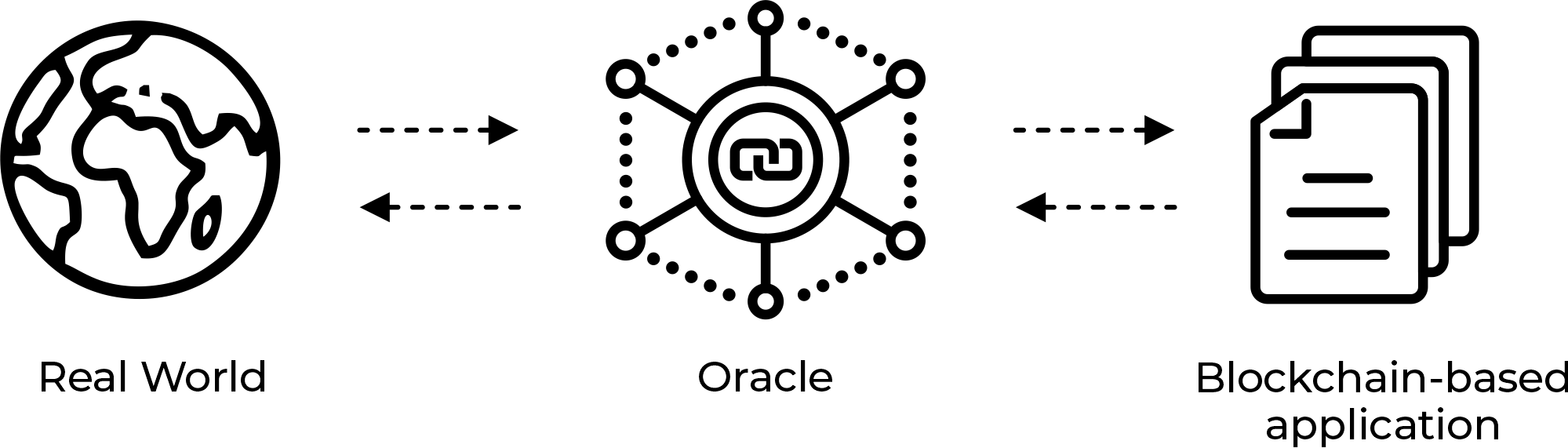
Source: Capital.com
In the DeFi space, services such as lending platforms, derivatives, and stablecoins rely on accurate pricing data provided by oracles. Faulty or manipulated data from an oracle can lead to erroneous decisions in smart contracts, resulting in financial losses, or even systemic collapse. Inaccurate price feeds can expose platforms to extreme volatility, resulting in unnecessary liquidations and potentially devastating financial consequences.
Innovation in oracle technology has established a new paradigm where decentralized systems no longer need to depend on centralized third-party data providers but access a resilient ecosystem where data is sourced from a diverse array of inputs. This advancement fosters greater security, reduces the risk of manipulation, and aligns with the core ethos of decentralization within blockchain.
1.1.1. Oracles in Action: Real-World Applications in DeFi
Oracles play an important role in DeFi applications like Aave and Compound. These platforms depend on oracles for real-time, precise asset valuations, ensuring stability in lending and borrowing markets. By continuously validating and delivering reliable data, oracles help safeguard against market manipulation and the risks posed by stale or inaccurate information. This functionality facilitates seamless transactions and upholds the integrity of the entire DeFi ecosystem, emphasizing oracles’ importance in maintaining operational efficiency and user trust.
The DeFi sector has been growing steadily over the past two years, since the previous bear market, with Total Value Locked (TVL) surpassing $200 billion.7DeFiLlama, Oracles Overview, TVL data for 2025, reported on March 18 , 2025, https://defillama.com/oracles# At its peak in December 2021, the sector recorded a TVL exceeding $250 billion,8DeFiLlama, DeFi Overview of historical data, reported on March 18, 2025, https://defillama.com/?volume%3Dfalse%26tvl%3Dtrue%26liquidstaking%3Dtrue%26vesting%3Dtrue# achieved within just a few years of its inception. As the industry evolves, it is expected to surpass previous all-time highs. The growth of Real World Asset (RWA) tokenization—projected to reach between $2 trillion and $30 trillion by 2030, according to various sources9Cointelegraph, Financial institutions will drive RWA tokenization’s trillion-dollar growth, November 15, 2024, https://cointelegraph.com/news/rwa-tokenization-trillion-dollar-growth-driven-financial-institutions#—signals a major expansion of on-chain financial markets. As blockchain adoption accelerates, the demand for oracles will continue to grow, solidifying their role as a foundational infrastructure layer in the broader digital economy.
1.1.2. Building Trust: The Security Role of Oracles in Blockchain
Oracles enhance user trust within blockchain applications by ensuring data accuracy and integrity. The emergence of decentralized oracles mitigates the risks associated with single points of failure found in centralized data providers. This shift creates a more secure environment, allowing users to engage in transactions with confidence, knowing that the data driving smart contracts is reliable.
How oracles protect against potential financial losses and systemic risks is demonstrated later in this report where we examine the implications of data breaches and inaccuracies.
Future Trends
The landscape of oracle technology is rapidly evolving, with oracles adopting emerging trends such as cross-chain oracles and the integration of artificial intelligence to enhance the data verification processes. These innovations have the potential to expand the capabilities of oracles, allowing for more sophisticated interactions between blockchain networks and off-chain data sources.
1.2. Historical Context
The concept of oracles has evolved alongside blockchain technology, emerging as a necessary solution to the limitations of closed blockchain systems. Initially, blockchains operated in isolation, unable to interact with external data sources. This limitation restricted their functionality and potential applications. However, as the demand for real-world data integration grew—particularly in the DeFi space—the role of oracles became increasingly significant.
Early oracles were often centralized, posing risks related to data integrity and reliability. As the pioneers in the blockchain ecosystem recognized these vulnerabilities, the development of decentralized oracles became a priority, ensuring that data could be sourced from multiple, trustworthy providers. Today, oracles are relevant for enabling a wide range of applications, from lending platforms to automated insurance contracts, and even in supply chain management and gaming.
This evolution highlights not only the important role of oracles in the blockchain ecosystem but also their adaptability in addressing emerging challenges. As the technology continues to mature, oracles will likely play an even more material role in bridging the gap between blockchains and the real world, expanding the possibilities of decentralized applications.
1.3. What’s Ahead: A Preview of Oracle Insights
In the following sections, we will explore the mechanisms behind blockchain oracles, their types, the risks associated with centralized providers, and decentralized alternatives. We will also discuss specific use cases, the current landscape of oracle technology, and future trends in this rapidly evolving field.
2. Understanding Blockchain Oracles
Blockchain oracles function as bridges between blockchain networks and the external world, enabling smart contracts to interact with data outside of the blockchain environment. Since blockchains are inherently closed systems, they cannot directly access external information, such as market prices, weather data, or event outcomes. Oracles solve this problem by securely providing off-chain data to on-chain smart contracts, enabling them to trigger actions based on real-world events or prices.
This section covers:
2.1. Mechanisms Behind Blockchain Oracles
2.2. Types of Blockchain Oracles
2.3. Risks of Centralized Providers: Limitations and Challenges
2.4. Decentralized Alternative to Mitigate Centralization Risks
2.5. Proprietary Data vs. Decentralized Data Needs in the Blockchain Ecosystem
2.6. Incentivizing Accuracy: Economic Models in Decentralized Oracles
2.7. Impact of Inaccurate Price Feeds on Blockchain Protocols
2.8. Use Cases of Blockchain Oracles
2.9. Emerging Applications for Blockchain Oracles
Key Terms in this Section:
Chainlink Risk Management Network (RMN): One of the validation systems for Chainlink services that independently verifies message integrity using off-chain nodes and on-chain contracts, ensuring security by detecting anomalies and pausing operations in case of potential risks.
Verifiable Random Function (VRF): Verifiable Random Function is a provably fair and verifiable Random Number Generator (RNG) that enables smart contracts to access random values without compromising security or usability.
Decentralized Exchanges (DEX): Allows users to trade cryptocurrencies directly with one another without relying on a central authority or intermediary.
Liquid Re-Staking (LRT): A mechanism that enables validators on Proof-of-Stake (PoS) blockchain networks to redeploy their staked assets to secure additional PoS-based chains.
Liquid Staking (LST): A process that allows users to stake their assets while receiving a liquid token representing their staked holdings, enabling them to participate in DeFi activities without locking up their funds.
Traditional Finance (TradFi): Refers to the conventional financial system, including banks, stock markets, and other regulated institutions.
Zero-Knowledge Proofs (ZKP): A cryptographic method that allows one party to prove the truth of a statement to another without revealing any underlying information.
2.1. Mechanisms Behind Blockchain Oracles
2.1.1. Not All Data Requires Decentralization
It is important to note that not all data requires decentralization. While decentralization is important for certain types of data—especially those that impact the integrity and security of smart contracts—some data can be effectively managed through centralized sources. We are elaborating later in the report on which types of data do not necessitate decentralization.
2.1.2. Components of Blockchain Oracles
Blockchain oracles are constructed with various infrastructure layers and data retrieval and transfer mechanisms. The following four components are commonly found in most blockchain oracle systems:
1. Data Retrieval: Oracles fetch external data from various sources such as APIs, IoT devices, or data feeds. These sources could be anything from financial market data, weather conditions, sports scores, or even geographical locations.
2. Data Verification: Users require that data fetched by oracles is accurate. Many oracles use multiple data sources, data providers, or aggregation mechanisms to ensure the data is accurate before passing it on to smart contracts. This verification step is required for maintaining the integrity of blockchain protocols, as smart contracts depend on the data provided by oracles to execute actions.
3. Data Delivery: After verifying the data, the oracle transmits it to the blockchain, where the smart contract processes it. This can trigger specific actions, such as transferring tokens, executing trades, or enforcing predefined conditions.
4. Security and Transparency: To ensure data integrity, many oracles utilize decentralized networks of nodes for verification. While this method mitigates manipulation risks, challenges arise when data is sourced from proprietary systems. An example of proprietary data could be Bloomberg’s Credit Default Swap spread data. In such cases, the oracle must rely on trusted, independent data sources or a transparent verification process, allowing participants to challenge and validate the data through multiple verifiable sources.
This ensures that even proprietary or exclusive data can be trusted and remains transparent, reducing reliance on a single point of authority. As more complex assets are integrated on-chain, the need for such a system becomes necessary to avoid centralization and a single point of failure in the data chain.
API3 Decentralized Oracle Infrastructure

Source: API3 Blog
Additional Mechanisms in Blockchain Oracles
In addition to the core mechanisms outlined above, six other components enhance the functionality and reliability of blockchain oracles:
- Consensus Mechanisms: Some oracles utilize consensus algorithms to establish the validity of data sourced from multiple providers. This can involve a voting system where several nodes must concur on the data before it is transmitted to the blockchain, ensuring a higher level of accuracy and trustworthiness. For example, Chainlink employs a decentralized network of nodes that collectively verify data before it reaches the smart contract.
- Reputation Systems: Implementing reputation scores for data providers helps assess their reliability. Oracles can prioritize data from sources with higher reputation scores, enhancing overall trust in the information being delivered to smart contracts.For example, oracles may use historical performance data to assign scores, favoring providers with a track record of accuracy.
- Data Aggregation: Aggregation techniques compile data from various sources into a single feed, minimizing the impact of any single erroneous data point. This approach not only improves accuracy but also provides a more holistic view of the data landscape.For example, Band Protocol aggregates data from multiple feeds to create a comprehensive data set that smart contracts can rely on.
- Fallback Mechanisms: In scenarios where the primary data source becomes unavailable, fallback mechanisms maintain continuity by switching to secondary data sources. This ensures that the oracle remains reliable and can continue to provide accurate information.For example, if a weather data API fails, an oracle can automatically retrieve data from an alternative API with comparable information.
- Time Stamping: Including timestamps with the data provides context about when the information was retrieved. This feature is particularly important for time-sensitive applications, where the timing of data can significantly affect outcomes.For example, in financial trading applications, having the exact retrieval time of a price ensures trades are executed based on the most up-to-date information.
- Privacy-Preserving Techniques: Utilizing methods such as Zero-Knowledge Proofs (ZKPs) allows for the verification of data without revealing sensitive information. This ensures privacy while maintaining the integrity of the data being provided to blockchain protocols. For example, some oracles implement ZKPs to confirm the outcome of a bet without disclosing the actual details of the bet itself.
- Intersubjective Data: Unlike objective data, which can be directly verified through deterministic means, intersubjective data requires consensus to determine its validity. This type of data is often necessary for blockchain applications, such as governance decisions, prediction markets, and dispute-resolution mechanisms. For example, UMA’s Optimistic Oracle is designed to verify intersubjective data by allowing disputes to be resolved through economic incentives and decentralized participation. Rather than relying on a single source, UMA’s system enables a network of participants to challenge or confirm proposed data, ensuring a robust and flexible approach to verifying subjective claims in a decentralized environment. Another manner to validate intersubjective data is through human interpretation.
2.2. Types of Blockchain Oracles
By design, not all oracles are the same. There are some key design decisions that each oracle provider has made to tailor their solution to meet a specific set of requirements across types of data retrieval, query mechanism, data types, deployment environments, trust mechanisms, levels of centralization or decentralization.
2.2.1. Classification Based on Data Retrieval
- Software Oracles: These are the most common type, gathering data from online sources like APIs, websites, or other digital platforms.
- Hardware Oracles: These are physical devices that gather real-world data from the environment, such as temperature sensors, GPS devices, and seismometers.
- Inbound Oracles: Data is sent from the external world to the blockchain.
- Outbound Oracles: Data is sent from the blockchain to the external world or system.
Varieties of Blockchain Oracles

Source: Phemex
2.2.2. Classification Based on Query Mechanism
- Push-Based Oracles: These oracles actively send data to the blockchain when certain conditions or events occur.
- Pull-Based Oracles: These oracles provide data when requested by a smart contract. They fetch data on demand.
RedStone Oracles Architecture Features

Source: RedStone Oracle Docs
2.2.3. Classification Based on Data Type
- Price Oracles: Specialize in providing asset price feeds (e.g., cryptocurrency prices, commodity prices).
- Event Oracles: Deliver data related to specific events (e.g., weather conditions, sports outcomes).
- Randomness Oracles: Provide verifiable random numbers for applications like gaming or lotteries.
- Aggregation Oracles: Collect data from multiple sources and compute a consensus value, which can improve accuracy and reliability.
2.2.4. Classification Based on Deployment Environment
- On-Chain Oracles: Execute their logic entirely within the blockchain ecosystem, ensuring full transparency.
- Off-Chain Oracles: Rely on external data sources and external computations, which may later be verified on-chain.
- Hybrid Oracles: Combine both on-chain and off-chain processes to balance efficiency, scalability, and trust.
2.2.5. Classification Based on Trust Mechanisms
- Reputation-Based Oracles: Use reputation scores to weigh data sources, helping to identify reliable nodes.
- Multi-Signature Oracles: Require consensus among multiple independent nodes before data is submitted to the blockchain.
- Human Oracles: Rely on human judgment to verify or input data, useful for qualitative or subjective information.
2.2.6. Classification Based on Centralization
- Centralized Oracles: These oracles retrieve data from a single or highly concentrated set of data sources or providers. Relying on a concentrated set or a single data provider presents risks such as exposing smart contracts to potential manipulation, data integrity issues, and a single point of failure.
- Decentralized Oracles: The goal of these oracles aligns with that of public blockchains: to create a trustless system that cannot be manipulated by a single entity or concentrated group of participants. However, while decentralized oracles aim to reduce reliance on a single trusted party, they do not eliminate trust entirely; instead, they distribute it across multiple participants.
2.3. Risks of Centralized Providers: Limitations and Challenges
On the surface, it might seem sufficient for established entities to publish their data directly to the blockchain, allowing protocols to use this single source for their data requirements. These institutions have a wealth of data and an established reputation in the financial industry. However, relying on centralized providers comes with inherent risks.
Centralized systems are vulnerable to single points of failure, potential data manipulation, and the challenge of trust in a non-transparent environment. These issues are particularly concerning in decentralized systems, where the core ethos emphasizes reducing reliance on a single authority and ensuring that no single party can control or manipulate the data.
For example, consider a scenario where a smart contract is designed to execute financial transactions based on financial data provided by a reputed Traditional Finance (TradFi) institution. If this institution’s data feed were compromised or manipulated, the entire system relying on this data could be impacted, leading to potential financial losses, liquidations, or unfair outcomes. In such cases, participants have no recourse to independently verify the integrity of the data.
A real-world example occurred in May 2024 when the New York Stock Exchange (NYSE) experienced a technical issue that led to widespread trading disruptions10NBC News, New York Stock Exchange says technical issue fixed after Berkshire Hathaway incorrectly shown to fall 99%, June 3, 2024, https://www.nbcnews.com/business/markets/new-york-stock-exchange-technical-issue-berkshire-hathaway-halted-rcna155182#. Several major stocks, including Berkshire Hathaway, saw their prices fluctuate abnormally before being halted. The incident was caused by a malfunction in NYSE’s price bands. As a result, traders relying on real-time price data faced significant financial uncertainty, with some executing trades at incorrect prices before the issue was resolved.
Without an independent verification mechanism, market participants relying solely on this centralized data had no way to confirm its accuracy, leaving them exposed to financial risk. The NYSE incident highlights the dangers of relying on a single authoritative data source in financial markets and underscores the need for decentralized validation systems to enhance transparency, accuracy and resilience.
NYSE’s Price Bands Malfunction Impacting Berkshire Hathaway Stock

Source: Business Insider
Later in the report, we examine cases within the blockchain ecosystem where reliance on a centralized oracle in collateralized lending resulted in financial consequences, while also demonstrating that using multiple decentralized oracle providers offers the highest level of accuracy.
2.4. Decentralized Alternative to Mitigate Centralization Risks
To address the limitations posed by centralized data providers, decentralized oracles offer robust alternatives. Decentralized oracles utilize a network of independent nodes or data providers to retrieve, validate, and report data. Instead of relying on a single centralized provider, data is sourced from multiple independent providers, reducing the likelihood of manipulation or error. This network of nodes typically operates under a consensus mechanism, where a majority of the nodes must agree on the accuracy of the data before it is pushed onto the blockchain.
An example of this is Chainlink’s ‘Decentralized Oracle Networks (DONs), which involve a network of independent nodes that retrieve data from a variety of off-chain or on-chain data providers, aggregate it, and present it on the blockchain. This system is designed to prevent any single point of failure and reduces the potential for manipulation.
In contrast, a centralized data provider lacks the checks and balances of a decentralized system. While their data is often reliable, it remains susceptible to human error, biases, and single-party control. If the single data provider were to supply data directly to a blockchain, participants would have to trust the entity’s integrity without the ability to independently verify the data. This centralized trust model contradicts the decentralized nature of blockchain technology. It also introduces risks that decentralized oracles help mitigate.
It is common for DeFi protocols and dApps to integrate more than one oracle provider to distribute risk. By integrating multiple oracles, protocols can reduce reliance on any single source, and improve overall consistency. This approach helps filter out anomalies and ensures that data, such as asset prices, remains accurate and resilient to manipulation.
_______
Comparing Centralized and Decentralized Oracles
The following table provides a structured comparison between centralized and decentralized oracles, highlighting key differences and helping illustrate the trade-offs between control and transparency in oracle solutions.
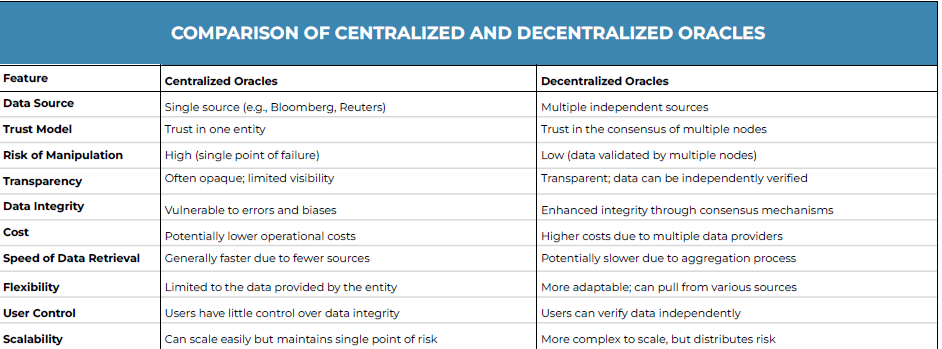
Source: Bering Waters
2.5. Proprietary Data vs. Decentralized Data Needs
in the Blockchain Ecosystem
Proprietary Data in Crypto-Assets
In the ever-evolving world of crypto-assets, not all data needs to be decentralized. In some cases, proprietary single-source data holds value. While decentralized oracles are key for trustless applications that require accuracy and transparency, certain scenarios demand exclusive access to proprietary data, either for competitive advantage or legal compliance.
In custodial services, platforms like Fireblocks, Anchorage, and Copper provide institutional digital asset custodial solutions for institutional clients, including secure key management and contract signing infrastructure. They also track user balances and internal transaction data that may not always be reflected on-chain, highlighting the role of proprietary data in operational efficiency.
Market makers such as Wintermute, Jump Trading, and GSR develop proprietary algorithms to analyze trading volume, order book depth, and arbitrage opportunities across exchanges. Public access to this data would erode their competitive advantage.
Enterprise-grade blockchain networks like Hyperledger and R3 Corda operate with proprietary data structures that ensure confidentiality in regulated environments such as banking, trade finance, and supply chains. These solutions facilitate enterprise-level solutions and private blockchains, where data remains proprietary.
Decentralized Data in Crypto-Assets
On the other hand, decentralized oracles play an important role in providing public, verifiable data for blockchain applications, ensuring transparency and fairness. DeFi protocols rely on decentralized oracles to accurately track asset prices, preventing manipulation and safeguarding financial integrity.
Beyond price feeds, decentralized data solutions support various other applications:
- On-Chain Randomness: Services like Chainlink VRF provide provably fair Random Number Generation (RNG) for gaming, lotteries, and other chance-based applications.
- Cross-Chain Messaging: Bridges like Axelar and LayerZero use decentralized relayers to securely transmit messages across different blockchains, enabling interoperability.
- Real-World Asset Verification: Tokenized assets, such as real estate and stocks, require decentralized verification to prevent reliance on any single entity and maintain trust in asset-backed tokens.
Conclusion
Both proprietary data and decentralized oracles serve distinct yet complementary roles in the blockchain ecosystem.
Proprietary data provides exclusive insights and strategic advantages for platforms that rely on controlled, private information, while decentralized oracles ensure transparency, security, and trust in public blockchain applications. In cases where verifiability and fairness are important, such as DeFi pricing, cross-chain messaging, and real-world asset verification, decentralized infrastructure provides a more robust solution.
The coexistence of both models underscores the need for a nuanced approach, leveraging each where they provide the most value.
2.6. Incentivizing Accuracy: Economic Models in Decentralized Oracles
Decentralized oracle networks rely on carefully designed economic incentive structures to ensure data accuracy and integrity. One common approach is the staking-based model, where node operators are required to lock up tokens as collateral before providing data; for instance, Chainlink has a staking system where operators must stake LINK tokens and risk having a portion of their stake slashed if they submit inaccurate data. RedStone Oracles plans to employ a similar mechanism that penalizes unreliable data submissions. Another model is the Proof-of-Stake system, used by Band Protocol, where token holders vote for validators who stake BAND tokens and risk penalties for dishonest behavior, ensuring accurate data reporting.
The UMA Data Verification Mechanism (DVM) ensures secure, decentralized data verification through an economic incentive model. At its core, it relies on UMA token staking, where participants vote on disputed data, with rewards for honest participation and slashing for dishonest actors. Furthermore, to manipulate the oracle, an attacker would need to acquire the majority of voting UMA tokens, making attacks economically infeasible. Voting participants earn inflationary rewards, reinforcing engagement and security. Combined with staking requirements, this structure aligns token holders’ incentives with the protocol’s integrity, ensuring trustless and tamper-resistant dispute resolution for decentralized applications.
Additionally, the first-party oracle model offers a distinct approach where data providers operate dedicated nodes—such as API3’s Airnodes—to deliver data directly to smart contracts minimizing intermediary risks.
Together, these models create a framework that rewards accurate data provision while penalizing errors or manipulation, ultimately maintaining the reliability and trustworthiness of data feeding into blockchain applications.
2.7. Impact of Inaccurate Price Feeds on Blockchain Protocols
Inaccurate price feeds can pose significant financial risks to blockchain protocols, leading to severe repercussions for users and platforms alike. When price distortions occur, they can trigger unintended liquidations, misprice assets, and create cascading failures across DeFi markets. An example occurred in April 2024, when ezETH, Renzo Protocol’s Liquid Restaking Token, de-pegged, resulting in approximately $60 million in liquidations across leveraged protocols like Gearbox and Morpho Labs.
Triggered by community reactions to the announcement of a REZ token airdrop, the value of ezETH plummeted by as much as 83% against its underlying ETH asset. Within less than an hour, prices in a low-liquidity, high-slippage Uniswap pool dropped to as low as $688, while more liquid pools on Balancer and Curve reflected values around $2,500 compared to that of ETH’s actual market value, which remained above $3,000. This disparity arose from some oracle providers reporting distorted prices due to maladjusted weights in trading pools.
Performance of Chainlink and RedStone Oracles
During this period of volatility, both Chainlink and RedStone Oracles demonstrated greater efficiency compared to other providers. The two oracles effectively captured the market realities more effectively by leveraging robust aggregation models and real-time adjustments.
RedStone Oracles and Chainlink’s Performance during ezETH de-Peg

Source: ezETH de-peg analysis
Additionally, RedStone Oracles exhibited a faster response time, as illustrated below. By leveraging slippage monitoring and median-based aggregation methods, RedStone mitigated extreme price swings, maintaining a more stable price above $2,960 throughout the event.11RedStone Docs, Renzo $ezETH Temporary de-peg, April 24, 2024, https://docs.google.com/document/d/1sRkwTsqc_rx77-bcfoYyxTANP5dlZSx9l3uxwfElUxE/edit?tab%3Dt.0%23heading%3Dh.lil37rqcogsd#
While no oracle can completely eliminate volatility, this event underscores the importance of oracles with built-in redundancies and adaptive pricing mechanisms to ensure greater stability in blockchain systems.
Another example of inaccurate price feeds impacting blockchain protocols occurred in November 2020 when Compound, a leading DeFi lending protocol, experienced mass liquidations totaling over $89 million due to an oracle exploit.12Decrypt, Oracle Exploit Sees $89 Million Liquidated on Compound, November 26, 2020, https://decrypt.co/49657/oracle-exploit-sees-100-million-liquidated-on-compound# The issue stemmed from a sudden, inaccurate spike in the reported price of DAI on Coinbase, which was used as a data source for Compound’s price oracle. The artificial price surge triggered significant liquidations of users’ collateralized positions.
Impact of Inaccurate Price Feeds on Compound

Source: Decrypt
These incidents highlight the role of reliable oracles in DeFi protocols. If a price oracle fails to deliver accurate, real-time market data, it can result in cascading liquidations and undermine trust in the protocol. To mitigate such risks, many blockchain protocols have since adopted more robust price aggregation mechanisms, such as median-based pricing models, which reduce the impact of outliers and multi-source data verification, to ensure the integrity and stability of their oracle-reliant systems.
2.8. Use Cases of Blockchain Oracles
Oracles extend beyond price feeds, enabling applications in DeFi, gaming, insurance, asset tokenization, and cross-chain interoperability. This section covers seven key applications and their role in blockchain infrastructure, followed by emerging use cases.
1. DeFi: In the DeFi sector, oracles provide real-time pricing data for digital assets, collateral management, and executing trades on Decentralized Exchanges (DEXs). Oracles have become fundamental in providing price feeds for tokens, stocks, commodities, and other assets. They play a pivotal role in various applications:
i) Decentralized Lending and Borrowing: Platforms, such as Aave and Compound, use oracles to obtain accurate price feeds for diverse assets. These feeds are crucial for assessing collateral values, calculating loan-to-value ratios, and ensuring algorithmic interest rate models function effectively. By preventing under-collateralization and triggering necessary liquidations, oracles maintain the stability and security of these platforms.
Oracle Function in Decentralized Lending and Borrowing

Source: ResearchGate
ii) DEXs: Oracles provide real-time price feeds, ensuring that assets are accurately priced and trades are executed at the correct prices. This data is integrated into smart contracts, allowing DEXs to maintain liquidity pools, and ensure transparent and efficient trading.
iii) Stablecoins: Oracles supply the necessary data for stablecoins to maintain their pegs. For example, MakerDAO13The Block, MakerDAO Integrates Chainlink Oracle to Help Maintain DAI Stability, February 9, 2023, https://www.theblock.co/post/210229/makerdao-integrates-chainlink-oracle-to-help-maintain-dai-stability# relies on Chainlink to manage its DAI stablecoin, which is pegged to the US dollar.
iv) Liquid Staking (LST) and Restaking (LRT): Oracles also price staking derivatives, such as stETH from Lido.14RedStone Oracles Blog, Case Study: RedStone Propelling DeFi with Lido’s stETH Price Feed, July 6, 2023, https://blog.redstone.finance/2023/07/06/case-study-redstone-oracles-propelling-defi-with-lidos-steth-price-feed# RedStone Oracles’ price feed for stETH is fundamental to enabling external protocols to price the token correctly as collateral or in other DeFi contexts.
v) Synthetic Assets: Oracles enable the creation of synthetic assets by providing and pegging the underlying asset to real-world data feeds. For example, Synthetix15Synthetix Docs, https://developer.synthetix.io/tokens/#—a decentralized synthetic asset issuance protocol—relies on Chainlink to obtain accurate price feeds for various assets, ensuring the proper valuation of synthetic assets.
Oracle Function in Synthetic Assets

Source: ResearchGate
vi) Perpetual Contracts: Oracles facilitate the accurate pricing and settlement of perpetual futures contracts. For instance, Drift Protocol,16Drift Protocol X (former Twitter): Migration to Pyth – Announcement, June 27, 2024, https://x.com/DriftProtocol/status/1806360865006064068# a decentralized perpetual exchange on Solana, leverages Pyth and Switchboard to access high-frequency market data, enabling efficient trade execution and liquidation processes.
2. Prediction Markets: Oracles enable smart contracts to execute functions based on real-world events. These contracts can trigger automatic payments, initiate processes, or record data as certain conditions are met. For example, decentralized prediction market platforms utilize oracles to feed real-world event outcomes into its smart contracts. By aggregating data from multiple trusted sources, these oracles verify the results of predictions—such as election results or sports scores—allowing the platform’s smart contracts to settle markets accurately and fairly.
Polymarket stands as one of the industry’s most established and widely recognized prediction markets, and it is also the most liquid. The platform has gained significant influence during major global events such as the 2024 U.S. Presidential Election, where over $3.6 billion17Polymarket, Presidential Election Winner 2024, November 5, 2024, https://polymarket.com/event/presidential-election-winner-2024/will-kamala-harris-win-the-2024-us-presidential-election# in wagers were placed.
Polymarket: 2024 U.S. Elections

Source: Polymarket
While Polymarket is designed to be oracle-agnostic, UMA is the exclusive oracle used for resolving markets on the platform. Since February 2022, UMA’s Optimistic Oracle has powered Polymarket’s outcome verification, securing over $3.6 billion in market volume during the 2024 U.S. Presidential Election. When a market is created, a request is automatically sent to UMA’s oracle. If the proposed outcome goes undisputed, it is accepted. In the case of a dispute, resolution escalates to UMA’s DVM, where UMA token holders vote to determine the final result.18Polymarket Docs, https://legacy-docs.polymarket.com/polymarket-%2B-uma#
Further strengthening this partnership, UMA, Polymarket, and EigenLayer have announced a collaboration to build the next-generation oracle for prediction markets, aiming to enhance security and efficiency in decentralized forecasting platforms.
3. Blockchain Interoperability: Interoperability infrastructure enables different blockchain networks to communicate and share data seamlessly. Oracles act as a bridge between these closed systems, ensuring that information from one chain can be accurately and securely transmitted to another. As blockchain protocols evolve into integrated solutions across multiple chains, interoperability becomes essential for their scalability, their ability to tap into different user bases, and tapping into liquidity on other chains
.
Interoperability between Blockchains

Source: Deloitte Article
An example of interoperability is Chainlink’s Cross-Chain Interoperability Protocol (CCIP). CCIP uses multiple decentralized oracle networks, including an independent Risk Management Network (RMN), to facilitate cross-chain communication by securely transferring data and assets between different blockchain networks. This approach allows protocols to access data from multiple chains and execute operations across various platforms without relying on centralized intermediaries.
4. Supply Chain Management: Oracles play a role in tracking the movement and status of goods as they pass through various stages of the supply chain. Traditional supply chain management often relies on centralized systems, resulting in inefficiencies, fraud risk, and a lack of transparency. By integrating blockchain technology with oracles, businesses can enhance traceability, automate processes, and ensure data accuracy across the entire supply chain.
One use case for oracles in supply chain management is the real-time tracking of goods, from raw materials to finished products. Oracles can fetch data from various external sources such as GPS systems, temperature sensors, and barcode scanners, feeding this information into smart contracts to trigger specific actions based on predefined conditions. This creates an immutable record of each step in the supply chain, facilitating the verification of goods’ authenticity and condition of goods.
For example, VeChain, a Layer 1 blockchain ecosystem, aims to enhance supply chain management and business processes, by using oracles to track the movement and condition of products in real-time. VeChain integrates Internet of Things (IoT) devices such as Radio Frequency Identification (RFID)19A wireless technology that uses electromagnetic fields to automatically identify and track tags attached to objects. tags, sensors, and Quick Response (QR) codes to collect and transmit real-time data about products’ journeys through the supply chain.20Dia Oracle Dashboard, VeChain (VET) API and Price Oracle, https://www.diadata.org/app/price/asset/VeChain/0x0000000000000000000000000000000000000000/# This data is then recorded on the blockchain, creating an auditable trail for verification and tracking.
The oracle ensures that real-time data from sensors and GPS systems is accurately fed into smart contracts, which can trigger actions like notifying stakeholders about delays or temperature deviations that could compromise product integrity.
VeChain Supply Chain Overview

Source: VeChain Blog
Another notable example is IBM Food Trust,21IBM, Food Logistics on Blockchain, https://www.ibm.com/blockchain/resources/food-trust/food-logistics/# a blockchain-based platform aimed at enhancing the transparency and traceability of food supply chains. Utilizing Hyperledger Fabric as its blockchain infrastructure, IBM Food Trust leverages IoT devices, direct data input, and APIs from supply chain participants to collect real-world information, such as product origin, shipping status, and quality control information. This approach allows stakeholders—such as farmers, manufacturers, and retailers—to verify the journey of food products from farm to table, ensuring food safety and quality throughout the supply chain.
Food Supply Chain Overview

Source: Kiosk Marketplace & Vending Times
5. Insurance: Oracles enable the automation of claims processing by providing real-time, verifiable data. Traditional insurance models often rely on manual claims assessments, which can be slow and error-prone. By integrating oracles into insurance smart contracts, the entire process can be streamlined and more transparent, reducing inefficiencies.
One of the primary use cases of oracles in insurance is parametric insurance22A type of insurance that automatically issues payouts based on predefined triggers, such as weather events or market conditions, rather than assessing actual losses. where smart contracts automatically trigger payouts based on predefined conditions linked to real-world data. For example, weather-based parametric insurance policies can be triggered by data from oracles that track weather events such as hurricanes, floods, or rainfall levels. If the data shows that a specific threshold (e.g., wind speed or rainfall amount) has been exceeded, the smart contract executes a payout to policyholders without requiring human intervention. This approach reduces the time and administrative burden typically associated with traditional claims processing, which can take weeks or even months.
Otonomi, a parametric cargo delay insurance solution provider, uses oracles for real-time, external data, which is an important component of its infrastructure. By integrating weather and logistics data from trusted sources, Otonomi can automatically assess and trigger claims based on predefined conditions, ensuring quick and transparent payouts.
Otonomi Oracle Infrastructure

Source: Chainlink Case Study (Otonomi)
Another notable example is flight delay insurance, where oracles track flight data from trusted sources such as aviation authorities or airport APIs. If a flight is delayed beyond a certain threshold, the oracle updates the smart contract with this real-time data, triggering an automatic payout to the policyholder. This eliminates the need for manual claims submission and approval.
Etherisc, a decentralized insurance platform, offers flight delay insurance powered by Chainlink. It utilizes Chainlink23Chainlink Blog, Supporting the Development of Blockchain-Based Insurance Solutions Through the Chainlink-Etherisc Joint Grant Program, March 11, 2022, https://blog.chain.link/chainlink-etherisc-joint-grant-program/# to provide real-time flight data—such as delays and cancellations—from trusted sources like aviation authorities and airline APIs. The smart contract automatically triggers payouts to policyholders when flights are delayed beyond a specified threshold.
Chainlink Insurance Infrastructure

Source: Chainlink Use Cases (Insurance)
6. Gaming and NFTs: Oracles observed a momentum in the gaming and NFT sectors, enabling real-world data to enhance interaction and the functionality of these digital ecosystems.
In gaming, oracles can power in-game economies, trigger in-game events based on real-world conditions, and even ensure the randomness and fairness of outcomes.
For example, Axie Infinity, a well-known blockchain-based game, uses oracles for game mechanics that depend on randomness, such as breeding mechanics and battles. These mechanisms are important to the game’s play-to-earn model and require fair Random Number Generation (RNG). By integrating Chainlink’s Verifiable Random Function (VRF),24Chainlink Ecosystem, Axie Infinity Integrates Chainlink Oracles!, November 16, 2020, https://www.chainlinkecosystem.com/ecosystem/axie-infinity# Axie Infinity ensures that the outcomes of these mechanics are verifiable and immutable, which also helps secure trust in the game’s economy and gameplay.
In the world of NFTs, oracles facilitate the authenticity, provenance, and price verification of digital assets. They can feed off-chain data into NFTs, such as confirming the real-world event or item that an NFT represents, or dynamically adjusting the value of the NFT based on external market conditions.
7. Identity and KYC: Oracles play a key role in verifying individuals’ identities in dApps and blockchain protocols that must comply with legal frameworks like Know Your Customer (KYC) and Anti-Money Laundering (AML). They streamline this process by fetching identity data from trusted sources, such as government databases, banks, or digital identity providers. As the industry matures and more institutional clients participate in blockchain ecosystems, the need for strict KYC and AML protocols increases. Oracles will be essential in integrating identity verification into dApps, a trend expected to grow in response to rising regulatory pressures.
Other Blockchain Oracle Use Cases
In addition to the established use cases for blockchain oracles illustrated above, several other potential applications are emerging.
These include facilitating secure voting systems, managing healthcare data, and enabling decentralized energy trading. Additionally, oracles can play a crucial role in legal contracts, and real estate transactions. The versatility of blockchain oracles in connecting smart contracts with real-world data highlights their importance across various sectors, driving innovation and improving efficiency in numerous applications.
2.9. Emerging Applications for Blockchain Oracles
In 2024, there was an increase in blockchain adoption activity by TradFi institutions. From the approval of BTC and ETH ETFs to major players like BlackRock entering the space, substantial advancements have emerged.
2.9.1. RWA Tokenization
Notable announcements by TradFi participants have included both pilots as well as real-world launches of tokenized financial assets on JPMorgan’s Onyx Platform (recently rebranded Kinexys), and HSBC’s Digital Vault for Tokenized Assets (Orion). Outside of tokenization, DBS Bank launched a Trade Finance platform based on blockchain technology.
The fact that these institutions have moved from piloting to actual launching of blockchain-enabled platforms that facilitate trade and investment using RWA demonstrates that TradFi in 2024 has moved away from experimentation and concluded that blockchain and digital asset infrastructure has a meaningful place in traditional financial services infrastructure.
As these institutions evolve, new use cases for oracles are emerging within the financial services sector, particularly in providing data feeds for pricing real-world assets and enhancing interoperability. The RWA market, which involves bringing real assets such as private credit, US treasury debt, commodities, institutional alternative funds, among other assets on-chain in tokenized form, is worth over $18.6 billion,25rwa.xyz, Global Market Overview, data reported on March 18, 2025, https://app.rwa.xyz/# and is projected to reach between $2 trillion and $30 trillion by 2030, according to various sources.26Cointelegraph, Financial institutions will drive RWA tokenization’s trillion-dollar growth, November 15, 2024, https://cointelegraph.com/news/rwa-tokenization-trillion-dollar-growth-driven-financial-institutions# According to data from RWA.xyz, the RWA tokenization sector has over 85,000 total asset holders, with approximately 150 different asset issuers.
Total RWA On-Chain Value

Source: rwa.xyz
The tokenization of RWAs offers numerous benefits, including greater access to liquidity, enhanced price discovery, lower settlement risk, and reduced friction and costs in asset issuance. Oracles will play a crucial role in tokenizing real-world assets such as real estate, equities, and commodities. They provide accurate pricing data and facilitate the verification of asset ownership and related documentation, enabling smoother transactions and better liquidity in the market.
Oracles are required both for fully on-chain assets (primarily for price discovery and locating liquidity) and for bridging with the off-chain world. For example, a tokenized real estate fund may have underlying documents such as property deeds and permit approval documents.
Today, in the United States, the National Best Bid and Offer (NBBO) regulation ensures stock brokers execute trades at the best price available. As traditional assets start to become traded in a broader set of trading venues than the traditional monolithic exchange, an NBBO construct—whether it is required by law or demanded by brokers to obtain the best pricing—will be increasingly important to ensure that customers can benefit from the best value. Oracles play an important role in aggregating data from a range of venues to be able to support price transparency.
2.9.2. Challenges for Oracles with RWA Tokenization
However, the application of oracles in RWA tokenization faces challenges. Ensuring data integrity is crucial; inaccuracies can lead to substantial financial repercussions. Depending on third-party data raises concerns about reliability, especially in sectors like real estate, where valuations can vary due to different appraisal methods.
Integrating oracles with legacy systems complicates data flow and increases costs. Regulatory compliance is another concern, as varying laws complicate oracle use in finance and insurance, where oversight is stringent. Transparency in oracle operations is essential for building trust; a lack of clarity can hinder acceptance.
Finally, fragmented standards in the oracle ecosystem can limit interoperability and affect liquidity. These challenges highlight the need for continuous innovation in oracle technology to fully realize the potential of RWA tokenization across various sectors.
2.9.3. Interoperability in Financial Services
Another emerging use case for oracles concerns interoperability for traditional institutional players using digital assets. The proliferation of platforms and protocols has fragmented the market, creating a hurdle for institutional adoption. Digital assets become limited to silos of small ecosystems of buy-side and sell-side market infrastructure institutions that have standardized on a particular platform, restricting their ability to participate in others.
This challenge presents an opportunity for oracles to evolve from merely providing asset data to providing a mechanism to support interoperability. As the blockchain landscape expands, oracles will enable seamless data transfer and communication across different blockchain networks, facilitating cross-chain transactions and enhancing the overall functionality of decentralized applications. Interoperability is becoming the key to institutional adoption of financial services by abstracting away the choice of issuance platform or blockchain “rail.” This relegates it to invisible plumbing, enabling institutions to connect their systems—whether order management systems or settlement infrastructure—to the on-chain world.
Chainlink CCIP is a key player in the space, having conducted interoperability pilots with SWIFT27Swift News, UBS Asset Management, and Chainlink successfully complete innovative pilot to bridge tokenized assets with existing payment systems, November 5, 2024, https://www.swift.com/news-events/press-releases/swift-ubs-asset-management-and-chainlink-successfully-complete-innovative-pilot-bridge-tokenized-assets-existing-payment-systems# , UBS, and Euroclear. Additionally, Ownera, while branding itself as an interoperability solution rather than an oracle, uses an oracle-based approach to support interoperability.
Ownera, HQLAᵡ, J.P. Morgan, and Wematch have successfully demonstrated the technical feasibility of executing a Delivery-versus-Payment (DvP) repo transaction—a mechanism ensuring that the transfer of securities occurs simultaneously with the payment—across two Distributed Ledger Technology (DLT) platforms at HQLAᵡ and J.P. Morgan.
The demonstration showed how rights to securities, recorded in Digital Collateral Records (DCRs) on the HQLAᵡ ledger, and digital cash, recorded at J.P. Morgan, could be recorded and transferred using two different DLT platforms.
The simulated transaction was negotiated in the Wematch trading front-end. Ownera connected Wematch and the two distributed ledgers using the open-source Financial Protocol for Peer-to-Peer (FIN P2P) routing protocol, ensuring the visibility of assets in Wematch and coordinating the DvP settlement across the HQLAᵡ and J.P. Morgan platforms.
Chainlink CCIP spans both institutional RWA and traditional cryptocurrency, providing support for the cross-chain transfer of value (e.g., ETH between different protocols).
2.9.4. Conclusion
While adoption by financial services institutions has been slow to take off, the dynamics of private capital—which in recent years has taken over as the thematic investment preference from public markets—signal a significant opportunity. By harnessing the efficiencies of digital assets, the fragmented and inefficient market landscape can be transformed, paving the way for greater innovation and integration within the financial sector.
3. Blockchain Oracle Landscape
The blockchain oracle landscape has become increasingly competitive, with multiple providers offering diverse solutions tailored to different market needs. The space continues to evolve rapidly from established players such as Chainlink and Pyth securing billions in total value to emerging protocols such as RedStone Oracles and Switchboard introducing novel architectures.
Each blockchain oracle operates with its unique architecture. While we have standardized key components for analysis, not all aspects are directly comparable, as each oracle is designed with specific mechanisms and priorities tailored to its use case.
This section provides a comparative analysis of the leading oracle networks, their core architecture, and how they differentiate in terms of scalability, security, and interoperability.
This section covers:
3.1. Current State of Blockchain Oracles
3.2. Chainlink
3.3. Pyth
3.4. RedStone Oracles
3.5. Chronicle
3.6. Switchboard
3.7. Core Similarities and Architectural Differences
3.8. Comparison of Oracle Growth Metrics
Key Terms in this Section:
- Total Value Secured (TVS): Total value secured measures the total financial value of assets that depend on a blockchain oracle for accurate data.
- Latency: The delay between the initiation of a request and the delivery of the corresponding response, often measured in milliseconds.
- Ethereum Virtual Machine (EVM): The decentralized computing environment that executes smart contracts on the Ethereum blockchain and Ethereum-compatible networks.
- Time-Weighted Average Price (TWAP): A trading metric that calculates the average price of an asset over a specified time period, helping to reduce the impact of market volatility on large trades.
- Liquidity-Weighted Average Price (LWAP): A pricing method that calculates an asset’s average price over a given period, weighted by the available liquidity at different price levels.
3.1. Current State of Blockchain Oracles
The expansion of the blockchain oracle market is evident in its Total Value Secured (TVS), which, in 2025, has oscillated around approximately $100 billion across more than 50 oracles—nearly doubling from approximately $50 billion in January 2024. This surge reflects rising trust and adoption as oracles secure a greater share of DeFi’s value.
Additionally, the TVS-to-Total Value Locked (TVL) ratio offers insight into the efficiency and utilization of secured assets within the ecosystem, underscoring the expanding role of oracles within the broader blockchain infrastructure. Today, based on commonly used aggregators, the TVS-to-TVL ratio stands at 0.43, with a TVS of $84.69 billion28DeFiLlama, Oracles Overview, data reported on March 18, 2025, https://defillama.com/oracles# and a TVL of $194.39 billion.29DeFiLlama, DeFi Overview, data reported on March 18, 2025, https://defillama.com/?volume%3Dfalse%26tvl%3Dtrue%26liquidstaking%3Dtrue%26vesting%3Dtrue# It is important to note that the TVS reported by selected oracles is higher than that reported by the aggregator; therefore, this ratio might be higher.
Chainlink continues to dominate the market, commanding over 50% of the market share, followed by Pyth, Chronicle, and RedStone. Collectively, the top five blockchain oracles account for approximately 80% of the aggregate value of assets secured by all oracles, highlighting the concentrated nature and intense competition among the key players in this industry.
The following section aims to dive deeper into the architecture and examines the unique features of some of the leading oracles in the industry.
Each blockchain oracle is built with its distinct architecture and operational mechanisms, making direct comparisons complex. While this report standardizes key components for structured analysis, it is important to recognize that not all aspects are directly comparable. Each oracle is designed to fulfill specific use cases with varying approaches to data aggregation, validation, security, and delivery. Readers should consider these nuances when interpreting the comparisons, as differences in features influence the strengths, trade-offs, and ideal applications of each oracle solution.
Comparison of Blockchain Oracle Features
The comparison table below highlights the architectural differences among leading oracle solutions, including Chainlink, Pyth, RedStone Oracles, Chronicle, and Switchboard, showcasing their core mechanisms, differentiation methods, and relevant metrics

Source: Bering Waters
3.2. Chainlink
Chainlink is the largest and most widely adopted blockchain oracle network, with over 50% of the market share in TVS across DeFi, institutional finance, and tokenized assets. Chainlink provides multiple services that extend beyond basic price feeds, enabling interoperability, proof of reserves, and identity verification. Chainlink is set to introduce a major architectural upgrade with the Chainlink Runtime Environment (CRE). This innovation will enable developers to design and deploy custom DONs workflows across data, compute, and execute interoperable seamless integrations across all blockchain ecosystems.
Chainlink’s infrastructure is built around the following models that address the varying needs of users:30Chainlink Blog, The Three Requirements of Tokenized Real-World Assets (RWAs) Solved by Chainlink, October 26, 2023, https://blog.chain.link/stages-enriching-real-world-assets/#
1. Data Feeds and Market Information: Chainlink Data Feeds aggregate and deliver financial data across commodities, equities, forex, economic indicators, and cryptocurrencies. The oracle provides 1,000+ price feeds from 25+ data providers. Chainlink offers both push, as well as hi-performance pull feeds, depending on the nature and needs of the application integrating them.
2. Proof of Reserve (PoR): Provides automated, real-time verification of asset reserves backing tokenized RWAs and stablecoins. This enhances transparency and risk management by enabling smart contracts to trigger circuit breakers if discrepancies arise between off-chain reserves and on-chain token balances.
3. Chainlink Functions: A serverless developer platform for fetching data from any API and running custom computation using Chainlink’s secure and reliable network. Any off-chain event or data can be synchronized or published on-chain, such as standing settlement instructions, corporate actions, proxy voting, Environmental, Social and Governance (ESG) data, dividends, interest, and Net Asset Value (NAV).
4. Decentralized Identity: Chainlink acquired privacy-focused oracle solution DECO from Cornell University. DECO leverages ZKP to verify identity and asset ownership without exposing sensitive information. This is critical for institutions needing to meet regulatory compliance requirements while maintaining privacy on public blockchains.
5. Cross-Chain Interoperability with CCIP: The Chainlink Cross-Chain Interoperability Protocol serves as a universal messaging and token transfer standard, enabling assets and data to move securely across multiple blockchain networks. CCIP functions as an abstraction layer that eliminates the need for institutions to integrate with individual chains, reducing time and costs.
6. Chainlink CRE: The Chainlink Runtime Environment (CRE) is a major upgrade that modularizes DONs, enabling developers to create custom workflows across data, compute, and interoperability. By executing code on CRE instead of on-chain, developers can build faster, integrate seamlessly across all blockchains, and deploy financial applications with built-in compliance and privacy features.
Chainlink Infrastructure Overview

Overall Oracle Architecture
- Data Sources: Chainlink integrates with a variety of external data providers, such as authenticated APIs, financial exchanges, IoT devices, and legacy enterprise systems to gather off-chain data.
- Decentralized Consensus: Chainlink’s decentralized network of nodes works together to ensure that data is validated and aggregated securely. This consensus ensures that the data sent to smart contracts is consistent and tamper-proof. With Offchain Reporting (OCR), nodes communicate through a peer-to-peer network, aggregate data off-chain using a lightweight consensus algorithm, and submit a single signed transaction on-chain. This improves scalability, reduces gas costs, and maintains the trustless security of Chainlink’s oracle network.
- Staking and Incentives: Chainlink uses staking as an incentive mechanism for node operators, to ensure they act honestly. If a node behaves maliciously or fails to deliver accurate data, it loses its stake, providing an additional layer of security to the oracle network.
3.3. Pyth
Pyth is one of the leading multi-chain oracles in the market. Pyth launched on Solana in 2021 and has since expanded to more than 93 blockchains. Pyth also boasts the highest number of data providers, with over 124 such providers.
Unlike traditional push oracles, Pyth allows for permissionless price updates. Pyth’s data providers submit data and interact with the on-chain contract, which is then combined by the oracle program to produce a single aggregate price and confidence interval. This system enables applications to utilize a single transaction flow that first updates the price and then executes the required application logic, making Pyth suitable for clients seeking real-time price feeds in DeFi and other protocols.
Overall Oracle Architecture31Pyth Docs, Design Overview, https://docs.pyth.network/price-feeds/how-pyth-works#
Pyth’s infrastructure is built around four key components: Data Publishers, Pull Oracles, Pythnet, and the Oracle Program. These components work together to aggregate, validate, and deliver price data to multiple blockchain ecosystems while maintaining decentralization and transparency.
- Data Publishers: Contribute pricing information to Pyth’s oracle program. These publishers come from a wide range of sources, such as financial institutions, exchanges, and market makers.
- Pull Oracles: In this model, prices are updated only when requested, unlike the Push model where oracles periodically update the price feeds. This offers several advantages, including higher update frequencies and lower latency. With pull oracles, smart contracts do not need to store prices and wait for periodic updates; instead, they request the latest price on demand, which is then sent to the blockchain in a single transaction.
- Pythnet: Pythnet is an application-specific blockchain designed by Pyth to aggregate pricing data from multiple sources and deliver it securely to the blockchain. Built on Solana’s technology, Pythnet operates as a decentralized computation substrate, aggregating data from multiple publishers before it is transmitted cross-chain to target blockchains.
i. Multiple data publishers contribute to each price feed.
ii. Prices aggregated on Pythnet are transmitted across various blockchains through the Wormhole bridge.
ii. Pythnet uses a validator mechanism similar to Solana’s mainnet but independent of it and is operated by Pyth’s data providers.
Pyth Cross-Chain Oracle Data Flow

Source: Pyth Docs
- Oracle Program: Handles multiple tasks, including maintaining a collection of price feeds and storing the contributions of various data providers for each feed. It aggregates the individual prices provided by these data sources into a single, unified price and confidence interval. Additionally, the program performs stateful computations on the resulting price data, such as calculating moving averages, to further refine the accuracy and reliability of the price series.
3.4. RedStone Oracles
RedStone Oracles is one of the fastest-growing oracles in the industry. Since its public launch in January 2023, it has expanded to 100+ blockchains, providing over 1,250 price feeds. RedStone serves 140+ clients, including blue chip protocols like Morpho, Spark, Compound, Venus, Ethena, Etherfi, and Pendle. Among multi-chain oracles integrated across five or more blockchains, RedStone ranks fourth with $8.36 billion32RedStone Oracles Website, data reported on 18 March 2025, https://www.redstone.finance/# in TVS, rapidly gaining market share from $110 million in TVS since January 2024.33RedStone Oracles Blog, RedStone Explosive Growth: The Blockchain Oracle of 2024, December 31, 2024, https://blog.redstone.finance/2024/12/31/redstone-explosive-growth-the-blockchain-oracle-of-2024-%25F0%259F%258C%25B3/#
RedStone Oracles integrates innovative infrastructure with a flexible modular architecture. It enables seamless asset integration and low-latency operations across diverse blockchain environments. This adaptability allows dApps to scale efficiently while incorporating the most advanced modules into their workflows.
Integration Models34RedStone Oracles Docs, Getting Started, https://docs.redstone.finance/docs/category/getting-started/#
RedStone Oracles offers several integration models to cater to different use cases:
- Pull Model: This model allows for on-demand data fetching, in which data is dynamically injected into user transactions. The entire process fits into a single transaction, reducing costs for protocols and smart contracts to access data feeds.
- Push Model: This model follows the traditional oracle approach, pushing data to the blockchain at defined intervals. It provides more control over update frequency and conditions, making it suitable for applications that require less frequent data updates.
- X Model: Designed for advanced protocols like perpetuals, options, and derivatives, the X model offers protection against front-running. It implements a deferred execution pattern where transactions are processed in two steps, with price data pushed on-chain only in the second step, usually at the very next block.
- ERC7412 Model: This model combines the push and pull approaches, allowing for both on-demand data fetching and periodic data pushing. It is useful for applications that require a balance between real-time data access and periodic updates.
RedStone Oracles Infrastructure Overview

Source: RedStone Oracles Docs
Overall Oracle Architecture
- Data Providers: These are entities that supply off-chain data to the RedStone Oracles network. They fetch data from various sources such as CEXs, DEXs, institutional APIs, and other price aggregators.
- Oracle Nodes: Nodes are responsible for collecting off-chain data, and refining it through configurable aggregation methods such as median, Time-Weighted Average Price (TWAP), or Liquidity-Weighted Average Price (LWAP). Once the data is processed, the nodes cryptographically sign the data packages to ensure security and integrity. The signed data is then broadcast to the Data Distribution Layer (DDL).
- Data Distribution Layer: The DDL functions as an off-chain storage system that holds signed data packages from oracle nodes. It ensures the availability of this data across supported blockchains and acts as a repository before the data is pushed on-chain.
- Relayers: Relayers fetch data from the DDL at fixed intervals and transmit it on-chain.
3.5. Chronicle
Chronicle Protocol, originally developed by MakerDAO’s Oracle team, was responsible for creating the first oracle on Ethereum. While Chronicle has secured over $20 billion for MakerDAO since 2017, their innovative solutions were initially exclusive to Maker and its ecosystem. In September 2023, with MakerDAO’s backing, the team expanded its vision by opening up Chronicle Protocol to the world, aiming to make its technology accessible to a broader user base.35Chronicle Blog, Chronicle Points Have Arrived, September 18, 2024, https://chroniclelabs.org/blog/chronicle-points-have-arrived#
Since its public launch, Chronicle has expanded its offering to DeFi and developed the Verified Asset Oracle (VAO), among the first oracles designed specifically for tokenized assets and RWAs.
The key aspect of Chronicle’s architecture is its Optimistic Schnorr design36Chronicle Protocol’s Scribe Oracle employs an Optimistic Schnorr hybrid design, which combines Schnorr signature aggregation with an optimistic verification model to enhance scalability and reduce gas costs. which allows for:
- Chain-agnostic functionality
- Scalability across multiple blockchains
- Lower gas costs for oracle updates
Overall Oracle Architecture37Chronicle Docs, Architecture, https://docs.chroniclelabs.org/Intro/dive/#
Two key aspects of an oracle architecture are on-chain components and off-chain components.
1. On-Chain Components:
- Validators: Responsible for gathering data from various sources and validating it through a MultiSig process. Each validator signs the data to ensure its integrity.
- Validator Registry: Maintains a list of all recognized validators, ensuring that only authorized and trusted participants are involved in the validation process.
- Quorum: The minimum number of validator signatures required for a data update to be considered valid. This improves decentralization and security as data is only accepted once the specified number of validators agree on its accuracy.
2. Off-Chain Components:
- Challenger: Listens for updates and ensures that invalid data is not processed. This creates an additional layer of protection, allowing for real-time corrections if any discrepancies are found.
- Origins: Data sources for asset prices that can exist on-chain from DEXs or off-chain from CEXs.
- Relays: These off-chain components listen to the peer-to-peer network and create Ethereum Virtual Machine (EVM) transactions out of the data from validators, which are then recorded on-chain
- Archiver: The Archiver stores all signed messages and data, ensuring that there is a verifiable and immutable record of all data transactions.
Chronicle Infrastructure Overview

Source: Chronicle Docs
3.6. Switchboard
Switchboard is a customizable, decentralized oracle protocol designed to provide high-fidelity, on-demand data for blockchain applications. By leveraging Trusted Execution Environments (TEEs) and a unique economic incentive model, Switchboard prioritizes secure, verifiable, and timely data delivery across multiple blockchain networks. This flexibility allows developers to create data feeds tailored to their specific application needs. With a recent update to Switchboard’s runtime framework, the oracle’s median latencies now sit at an average of 226 milliseconds.
Key Features
- On-Demand Data Feeds: Unlike traditional oracles that push data at regular intervals, Switchboard employs an on-demand model where data is fetched only when requested. This approach conserves resources and ensures that applications receive the most up-to-date information.
- Trusted Execution Environments: By utilizing TEEs, Switchboard enhances security and data integrity. TEEs provide a secure area within a processor, ensuring that data is processed in a tamper-proof environment, which is crucial for handling sensitive information.
- Verifiable Randomness: Switchboard offers a mechanism for generating provably fair and fast randomness. This feature is important for applications like gaming and lotteries, that require unbiased random number generation.
- Data Aggregation: The protocol supports the aggregation of data from multiple sources, including other oracles, to enhance accuracy and redundancy. This capability allows for the creation of comprehensive and reliable data feeds.
Overall Blockchain Architecture38Switchboard Docs, Architecture Design, https://docs.switchboard.xyz/understanding-switchboard/introduction/switchboards-architecture-tech-stack-and-security#
Switchboard’s architecture is designed to prioritize security, flexibility, and efficiency. Key components include:
- Oracle Queues: These serve as subnetworks within Switchboard, maintaining lists of oracles responsible for resolving jobs and publishing data. Each data feed is assigned to a specific queue, ensuring organized and efficient data management.
- Guardians: Acting as gatekeepers, guardians verify that oracles are running approved code within TEEs. They play a key role in maintaining the integrity and security of the network by ensuring that only trusted oracles participate in data processing.
- Oracles: These nodes execute tasks such as data fetching, processing, and signing. They operate within isolated TEE runtimes, ensuring that data is handled securely and efficiently. Oracles are organized into components like the Oracle Router front end, Oracle Router (Gateway), and Oracle Worker, each with specific roles in data processing.
- Oracle Router (Gateway): This component manages the data request distribution among oracles, based on current oracle stake, performance, and capacity, ensuring efficient handling and balanced workload across the network.
- Oracle Worker: The final destination for user requests, the Oracle Worker fetches, processes, and signs data. It operates a Task Runner to execute specific tasks, ensuring that data is accurately and securely delivered to applications.
Switchboard Infrastructure Overview

Source: Switchboard Team
3.7. Core Similarities and Architectural Differences
Blockchain oracles share core similarities, particularly in using push and pull mechanics for data delivery. Most oracles employ a push model, where data is periodically sent to the blockchain, ensuring that smart contracts have access to up-to-date information. Conversely, some oracles utilize a pull model, allowing smart contracts to request data on demand, which can enhance efficiency and reduce latency.
Despite these common approaches, oracles differentiate themselves through their specific implementations and unique features. For instance, Chainlink offers a suite of services beyond basic data feeds, including proof of reserves and cross-chain interoperability. In contrast, Pyth’s emphasis on permissionless updates and real-time price feeds caters to applications requiring accurate high-frequency data.
Each oracle’s architectural choices, such as the use of decentralized consensus mechanisms, security, and integration capabilities, ultimately define its value proposition in the competitive landscape.
Latency, throughput, and cost are important metrics for evaluating oracle performance, but they are not standardized across the industry. These metrics can vary depending on the location, network conditions, and the specific benchmarking methodology used, making direct comparisons challenging. Additionally, costs fluctuate based on multiple factors, including token price, governance decisions, and the gas fees of the target blockchain. While exact standardization is difficult, we provide available data where possible.
For example, Pyth’s price feeds update every 400 milliseconds, and Pythnet currently facilitates approximately 1,000 transactions per second (TPS), with throughput scaling based on the number of available price feeds. RedStone Oracles updates price feeds every ~20 milliseconds, with a pull model supporting over 1,000 assets and a push model handling around 100,000 on-chain updates daily.
Given these variations, readers should interpret these metrics within the context of each oracle’s unique architecture and operational model.
3.8. Comparison of Oracle Growth Metrics
The table below presents a comparative analysis of growth metrics for leading oracle networks, including Chainlink, Pyth, RedStone Oracles, Chronicle, and Switchboard. Key factors covered include Total Value Secured (TVS), integrated protocols, data providers, validators, and the number of price feeds.
Sources for the information in this table are listed below the data, with selected figures obtained directly from the respective oracle project teams. While discrepancies may exist between these figures and those published by public aggregators such as DeFiLlama, we have chosen to present data sourced directly from oracle teams or from publicly available materials published by the oracles themselves.

Source: Bering Waters
4. Oracle Tokens
Oracle tokens are native assets within oracle networks that support the operation and governance of decentralized data systems. These tokens facilitate the overall incentive structure within an oracle ecosystem. Oracle tokens are used to compensate data providers, incentivize oracle node operators, and facilitate governance decisions. Additionally, they help maintain data integrity and ensure the overall security and reliability of the network.
Oracle networks typically design their tokens with specific functions to support decentralization, ensuring that no single entity controls data feeds or validation processes.
This section covers:
4.1. Historical Context of Oracle Tokens
4.2. Utility of Oracle Tokens in the Ecosystem
4.3. Publicly Listed Oracle Tokens: Economic Models, Metrics and Performance
Key Terms in this Section:
- Fully Diluted Valuation (FDV): The total market capitalization of an asset, including crypto assets, assuming all issued and unissued units are fully released and in circulation
- Token Generation Event (TGE): The initial creation and distribution of a project’s native tokens, typically marking their first issuance on a blockchain.
- Initial Coin Offering (ICO): A fundraising method where a blockchain project sells its newly issued tokens to investors in exchange for capital, often used to fund development.
4.1. Historical Context of Oracle Tokens
The concept of oracle tokens has evolved significantly since the inception of blockchain technology. Initially, oracles served as simple mechanisms providing external data to smart contracts, primarily focusing on price feeds for cryptocurrencies. Early oracles relied on centralized data sources, which raised concerns about reliability and trust. As the demand for DeFi and dApps grew, the need for decentralized solutions became apparent, leading to the emergence of projects like Chainlink in 2017.
These decentralized oracles introduced token-based incentives to ensure data accuracy and reliability, with LINK tokens created to reward data providers and secure the network. As the ecosystem matured, the utility of oracle tokens expanded; they began to function also as governance tools, enabling token holders to influence protocol decisions and upgrades.
Recent developments have introduced staking mechanisms, requiring node operators to stake tokens to participate in the network, thereby aligning their financial interests with data accuracy and enhancing security. Today, various oracle projects, such as Pyth and UMA, leverage tokens to incentivize participation, enhance governance, and promote ecosystem growth, reflecting the ongoing need for reliable data in a decentralized environment and underscoring the role of oracle tokens in the blockchain ecosystem.
4.2. Utility of Oracle Tokens in the Ecosystem
Oracle tokens play an important role within an oracle network, facilitating various functions that ensure the system operates effectively and securely. They serve multiple purposes, including incentivizing data providers, enhancing network security, enabling governance participation, covering transaction fees, and promoting ecosystem growth. Each of these roles contributes significantly to the overall functionality and sustainability of the oracle ecosystem, and the following sections will provide a detailed examination of these utilities.
- Incentivizing Data Providers: Oracle tokens incentivize data providers to submit accurate and timely off-chain data to the oracle network. Providers may earn tokens as rewards for submitting valid data.
Example: In the Chainlink network, LINK tokens are used to compensate oracle nodes for data and services rendered. Node operators earn LINK tokens as rewards when their submitted data passes the validation process.
- Staking and Security: Oracle tokens are commonly used by node operators to stake their tokens within the network. This staking process acts as collateral, ensuring that the node operators are financially incentivized to provide accurate and reliable data. If a node operator submits false data or fails to provide data as required, they risk losing a portion or all of their staked tokens as a penalty.
Example: RedStone Oracles has implemented a staking mechanism for node operators. Data providers are required to stake RED tokens, and in the event of downtime or significant inaccuracies in the data provided, the node operators will be automatically penalized through a slashing mechanism, forfeiting a portion of their staked tokens.39Epicenter Podcast, RedStone: The Oracle Pioneering the Future of DeFi – Marcin Kaźmierczak. Ep. 581, January 9, 2025, https://www.youtube.com/watch?v%3DFFW8lPuwCBI#
- Governance: Oracle tokens serve as governance tokens, allowing holders to participate in the decision-making process regarding the network’s future direction. Token holders can vote on protocol upgrades and other decisions affecting the functionality and direction of the oracle network.
Example: UMA token holders can participate in various governance activities, including voting on UMA Improvement Proposals, price requests, and disputes in UMA’s DVM.40UMA Docs, Governance, https://docs.uma.xyz/community/governance# By staking UMA tokens, holders not only participate in governance but also help secure the oracle. They are rewarded for correct votes but face slashing penalties for incorrect ones.
- Transaction Fees: When a smart contract requests data from an oracle network, it pays a transaction fee in oracle tokens. These fees cover the costs of maintaining the oracle network infrastructure, including node operation and data validation.
Example: In Chainlink, users pay LINK tokens to request data from oracle nodes. This fee compensates node operators for their services, ensuring the network’s continued functionality. Users can also pay with the tokens and assets they already hold, which are then converted to LINK using Chainlink Payment Abstraction.
LINK Token Utility

Source: Chainlink Blog
5. Growth and Adoption: Some oracle projects provide incentives for developers and third-party projects to build on their networks and utilize their services. These incentives, often distributed in tokens, promote adoption, encourage developers to integrate oracles into their applications and foster ecosystem growth.
Example: Pyth launched the Ecosystem Grants Program, allocating 50 million PYTH tokens to incentivize contributions to Pyth’s development through educational and research initiatives, as well as to drive greater adoption within the Web3 community.41Pyth Blog, Launch of Pyth Ecosystem Grants Program, May 16, 2024, https://www.pyth.network/blog/pyth-ecosystem-grants-program#
4.3. Publicly Listed Oracle Tokens: Economic Models, Metrics and Performance
All of the leading multichain oracle protocols discussed in this report have launched their own native tokens—except for Chronicle and Switchboard. The most recent among them is RedStone Oracles, which launched its RED token in March 2025.42Binance, Introducing RedStone (RED) on Binance Launchpool and Price Cap Mechanism for Binance Pre-Market, February 25, 2025, https://www.binance.com/en/support/announcement/detail/5e1eb05676a0492f889db144b46d439b#
4.3.1. Economic Models of Oracle Tokens
The economic models of oracle tokens play a role in their value and functionality within decentralized networks. These models are shaped by supply and demand dynamics, token utility, and mechanisms such as inflation, deflation, and token burns.
Demand for oracle tokens is driven by their various use cases, including payments for data services, staking for network security, and governance participation.
For example, leveraging RedStone Oracles’ EigenLayer Actively Validated Service (AVS), RED staking adds a robust layer of economic security to RedStone’s oracle stack by utilizing staked RED and potentially tapping into billions of dollars staked in EigenLayer for additional security. RED can be staked by data providers who supply data to RedStone’s modular oracle network, and token holders who enhance network security through direct staking in the RedStone AVS. RED stakers can earn rewards from RedStone data users across hundreds of blockchains, paid in widely adopted assets like ETH, BTC, SOL, and USDC.
Supply models differ across projects, with some tokens having fixed supplies, while others use inflationary issuance to incentivize participation, which, if not managed well, can dilute value. Deflationary mechanisms, such as token burns, help maintain scarcity and counteract inflationary pressures.
Additionally, market sentiment, partnerships, and technological advancements can significantly impact token valuations. A sustainable oracle token model requires balancing incentives for node operators and data providers while ensuring long-term network stability and growth.
Comparison of Publicly Listed Token Metrics
The comparison table below outlines the native tokens of prominent multi-chain oracle protocols.
Chronicle and Switchboard are excluded from this analysis, as they have not yet launched native tokens.
To provide a broader perspective on how oracle tokens function, we’ve included examples like Band Protocol and API3. Although they are not the primary focus of this report, both projects maintain substantial Total Value Secured (TVS) and offer compelling insights into diverse token utility models within the oracle ecosystem.

Source: Bering Waters
5. Funding Rounds & Cap Table Insights of Leading Oracles
This section delves into the funding trends within the blockchain oracle industry, providing insights into the fundraising positioning of oracle projects in comparison to similar verticals. It highlights key dynamics in blockchain oracle funding and explores the primary drivers of oracle demand. Additionally, the analysis focuses on the strategic backers that support oracles in this hyper-competitive environment, shedding light on their role in driving innovation and growth. The section also reviews recent capital raises in the sector and outlines the capital requirements necessary for the future success and scalability of oracle projects, emphasizing the vital role these investments play in shaping the blockchain oracle ecosystem.
A comparative analysis table provides a side-by-side view of funding amounts, valuations, and investor participation across five major oracle providers, including Chainlink, Pyth, RedStone Oracles, Chronicle, and Switchboard.
This section covers:
5.1. Key trends in Blockchain Oracle Funding
5.2. Recent Capital Raises in Blockchain Oracles
5.3. Comparative Analysis of Leading Oracles: Funding History and Valuations
5.4. Market Comparisons
5.5. Unlocking the Future: Capital Investment Requirements for Blockchain Oracles
5.1. Key Trends in Blockchain Oracle Funding
Ultimately, investors in oracles are seeking long-term appreciation of the price of the token that powers and secures the oracle. That appreciation occurs as demand for on-chain and cross-chain data integration grows and the token becomes a scarce resource. Long and short-term investors will also affect pricing dynamics by bidding up the token in anticipation of gains in the future.
While the long-term demand for oracles appears likely based on trends in adoption metrics that this report has articulated, this token scarcity needs to be balanced by the fact that on the supply side, there is a proliferation of new projects, that are competing for a limited pool of investment.
To recap the key drivers for oracle demand, these include: the increase in use of DeFi requiring aspects such as pricing feeds; the merging of the new and traditional finance sectors necessitating the ability to reference data concerning RWAs which reside outside the realm of blockchain; the rise of collectibles, such as NFTs; and the proliferation of new blockchains which require interoperability either to move value or data between these heterogeneous networks.
Strategic Capital and Market Validation in the Oracle Ecosystem
Given the multitude of oracle projects that have launched or are expected to launch in the future, not all will be successful. That is an accepted and typical part of the evolution of new technology which as seen in the recent adoption of Web 2.0 and some early blockchain networks. In 2023, defunct crypto projects accounted for $940 million in investment.43RootData, 2023 Crypto Dead Projects List, June 07, 2023, https://www.rootdata.com/Archives/detail/2023%2520Crypto%2520Dead%2520Projects%2520List?k%3DNzk5#
Successful investors are those who are able to identify patterns that indicate a high likelihood of success. These patterns include: a project team with a track history of success, a credible community of investors with a clear investment thesis and historical evidence of successful exits, demonstrated user demand, a distinct value proposition, and a strong competitive moat.
From an investor’s perspective, several established blockchain venture firms with long-term strategic investment theses in oracle technology have been deploying capital since 2021, lending credibility to the space. These firms include Multicoin Capital, Blockchain Capital, Distributed Global, Lemniscap, Spartan Group, and Maven11. Their participation reflects a strong interest and confidence in the potential of oracles to address critical challenges within the blockchain ecosystem.
Moreover, the backing of these key investors often signifies a robust validation of market opportunities and technological advancements in the oracle segment. Their strong track record in blockchain investments brings not only financial resources but also invaluable expertise to the projects they support. This expertise includes insights into market dynamics, strategic guidance on product development, and access to expansive networks within the blockchain community.
Recent funding rounds have attracted investments from TradFi institutions such as Franklin Templeton. In this growing trend of TradFi institutions investing in oracles for the first time in 2024, they are increasingly recognizing the strategic value of blockchain oracles. As TradFi begins to invest in these innovative solutions, it signals a broader convergence between conventional markets and the emerging decentralized ecosystem, reinforcing the critical role that oracle technology is expected to play in shaping the future of finance.
The confidence demonstrated by these prominent backers indicates a collective belief in the transformative potential of oracles, positioning them as essential components in the broader blockchain landscape.
These strategic investments serve not only as a vital source of capital but also as a catalyst for the exchange of expertise and resources among diverse projects. The engagement of distinguished individuals and institutions significantly bolsters the credibility of these initiatives, paving the way for innovative collaborations that can propel technological advancements within the oracle sector.
By forging alliances with esteemed figures and organizations, oracle projects can harness complementary strengths, resulting in enhanced data integration solutions and the cultivation of a more resilient ecosystem. This spirit of collaboration is essential for adeptly navigating the intricate dynamics of the blockchain landscape, thereby accelerating the widespread adoption of oracle technology across a myriad of applications.
Such synergies not only enrich the projects involved but also contribute to the overall maturation and sophistication of the blockchain industry.
Investor Impact, Enhancing Market Credibility and Ecosystem Synergies
There are three key archetypes: investments by well-regarded individual investors who by lending their name provide a signal to the market that a project is highly credible; investors who both deploy capital but also provide advice, guidance, and access to an ecosystem of partners through their investment portfolio; and investors that offer some other form of synergies, such as exchanges, that provide access to liquidity.
An example of investments by well-known individuals in the blockchain space is Redstone Oracle’s Series A round, which included participation from influential figures such as Rok Kopp, Mike Silagadze, Jozef Vogel, the leadership team at EtherFi; Daniel Dizon, Founder at Swell; as well as Jeff Yin, Founder and CEO at Merlin. This exemplifies how the backing of established leaders is tailored to foster partnerships.
An example of an oracle where investors not only deploy capital but also bring but also promote the sharing of expertise and resources among projects is Switchboard. Investors include Aptos, Mysten Labs (the developer of Sui), StarkWare, and the Solana Foundation.
Additionally, venture arms of trading desks and exchanges are investing in oracles, with firms like Amber Group, HTX Ventures, and Coinbase Ventures participating in funding rounds of Redstone Oracles. Notable market makers and trading firms such as Jump Trading, CMT Digital, and Wintermute invested in Pyth. These firms play a key role in providing liquidity and fostering partnerships that support the growth and development of oracle technologies.
These investments not only support the growth of individual projects but also contribute to the overall advancement of the oracle ecosystem. As these projects evolve, they lay the groundwork for more sophisticated data integration solutions, ultimately enhancing the functionality and adoption of decentralized applications across the blockchain landscape. Additionally, they play a key role in bridging the gap between decentralized and traditional financial systems, thereby fostering a more integrated financial landscape.
Additional Observations
- Early Stage Capital Requirements for Oracle Maturation
Most oracle projects are still in their early stages, with a significant portion of funding occurring between Seed and Series A rounds. New projects enter the market seeking early-stage capital opportunities and attracting funding from savvy investors. Oracles founded in 2021 and earlier are maturing and require additional capital to refine their offerings and scale.
Funding Rounds Data Privacy
The privacy of financial details in funding rounds reflects the maturing nature of the oracle markets. As this sector evolves, companies may choose to keep sensitive information private to protect their competitive advantages.
Despite this strategic privacy, there remains a strong interest in investments within the oracle sector. Investors seem to recognize the high potential of the projects in the orcales space, acknowledging the promise of transformative change and innovation.
Funding Hotspots: North America and Europe
Funding in the oracle sector has been predominantly concentrated in regions with robust blockchain ecosystems, particularly North America and Europe. This trend mirrors the broader dynamics of the blockchain industry, which also shows a strong presence in these areas. Additionally, many oracle teams operate from North America and Europe, further emphasizing the influence of these regions in shaping the future of the blockchain and oracle sectors.
5.2. Recent Capital Raises in Blockchain Oracles
In 2024, several prominent oracle projects have secured significant funding rounds backed by leading industry investors, highlighting a growing interest in the oracle space.
Established Oracle Projects
- RedStone Oracles secured $15 million in a Series A round, led by Arrington Capital.
- Switchboard raised $7.5 million in a Series A round, led by Tribe Capital and RockawayX.
- API3 disclosed securing $4 million through a private sale as part of its Strategic Treasury Diversification Round, selling 1.4 million API3 tokens at a 20% discount to the 7-day TWAP. The round included participation from Spartan Group, Laser Digital, DWF Labs, and Caladan.
Notable Oracle Projects with Continued or New Funding
- Ora44Ora Blog, ORA Raises $20M in Funding to Tokenize AI Models and Enable Decentralized AI Oracles, June 26th, 2024, https://mirror.xyz/orablog.eth/ILU7CBLuNzSS2yvLJsb2r_EoOC_EuqVb7LXeZx_Pca0#, a verifiable oracle protocol that enables AI on blockchains, raised $20 million to tokenize AI models and create decentralized AI oracles, with investors, such as Polychain Capital, Hashkey Capital, and SevenX participating
- APRO Oracle45Cointelegraph, APRO Oracle raises $3M in seed round led by Polychain Capital, Franklin Templeton, and ABCDE Capital, October 7, 2024, https://cointelegraph.com/press-releases/apro-oracle-secures-3m-seed-funding-to-pioneer-new-standards-for-decentralized-oracles# raised $3 million in its seed round led by Polychain Capital, Franklin Templeton, and ABCDE Capital.
These funding activities reflect a broader trend of increased investment in oracle technologies, driven by their essential role in bridging real-world data with decentralized applications and the growing demand for more sophisticated data solutions in the blockchain ecosystem.
5.3. Comparative Analysis of Leading Oracles: Funding History and Valuations
The comparative analysis table below provides an overview of the funding history of leading blockchain oracles, comparing total amounts raised, their strategic backers, valuations, and the percentage of tokenomics allocated to investors.
As we review the top five oracle projects in the comparative table, it’s important to note that Chronicle stands out by not having conducted traditional funding rounds with third-party investors—it was initially bootstrapped through MakerDAO. However, according to the team, Chronicle may be considering pursuing external funding in the near future, potentially in 2025, pending confirmation.
Appendix A provides detailed information on the past funding rounds of the illustrated five oracle projects below.

Source: Bering Waters
5.4. Market Comparisons
When comparing funding trends across blockchain sectors, the oracle industry exhibits a unique trajectory focused on building the essential infrastructure that underpins multiple blockchain applications. While DeFi has attracted investments aimed at expanding financial products and user adoption, oracle projects have drawn a more measured, infrastructure-focused approach.
In 2024, venture capital firms invested approximately $13.7 billion46The Block, The Funding: Crypto VC Recap 2024, December 29, 2024, https://www.theblock.co/post/332539/the-funding-crypto-vc-recap-2024# in crypto and blockchain startups, a 28% increase from 2023. A significant portion, around $5.5 billion across over 610 deals, was specifically invested towards blockchain infrastructure and scaling blockchain networks. These infrastructure investments, aimed at improving speed, cost, and scalability through Layer-2 solutions, modular technologies, liquid staking protocols, and developer tooling, underscore the market’s emphasis on scalable systems.
While the absolute funding levels for oracles might be lower than other more established verticals within blockchain infrastructure, for example cross-chain interoperability solutions and liquid staking/restaking, this is partly due to the early-stage nature of investments in oracles and the fact that some funding remains undisclosed. Nevertheless, their strategic importance is clear—they provide reliable, real-time data that powers the next generation of blockchain networks, bridging traditional finance with emerging digital ecosystems.
5.5. Unlocking the Future: Capital Investment Requirements for Blockchain Oracles
The transition from the current Total Value Secured (TVS) by oracles, estimated to be in the vicinity of $100 billion47DeFiLlama, Oracles Overview, data reported on March 18, February 18, 2025, https://defillama.com/oracles#, to a projected $2 to $30 trillion48Cointelegraph, Financial institutions will drive RWA tokenization’s trillion-dollar growth, November 15, 2024, https://cointelegraph.com/news/rwa-tokenization-trillion-dollar-growth-driven-financial-institutions# in on-chain assets by 2030, where oracles have the potential to secure approximately 50% of this value based on current and historic TVS-to-TVL ratios—will require a substantial increase in capital investment in the blockchain oracle sector. Below are five key factors that highlight the immense scale of funding projected to fuel this growth:
- Exponential Growth in Demand: As blockchain technology becomes increasingly integrated into industries such as finance, supply chain, gaming, and RWA tokenization, the demand for oracles to connect on-chain and off-chain data will grow significantly. Oracles will need to scale their infrastructure to handle trillions of dollars in assets securely and efficiently.
- Technological Complexity: The oracle sector is evolving to support advanced integrations with emerging technologies like Artificial Intelligence (AI), Machine Learning (ML), and the Internet of Things (IoT). These advancements require substantial funding for research, development, and deployment of high-performance oracle solutions capable of managing complex data flows and computations.
- Scalability and Interoperability: To meet the needs of a rapidly expanding decentralized finance (DeFi) ecosystem and broader blockchain adoption, oracles must achieve greater scalability and interoperability. This includes building cross-chain communication protocols, DONs, and robust security mechanisms to ensure data integrity across diverse applications.
- Real-World Asset Tokenization: The tokenization of RWAs is projected to reach between $2 trillion and $30 trillion by 2030. Oracles will play a key role in providing accurate and secure data feeds for these assets, necessitating significant investments in infrastructure and partnerships with enterprises and governments.
- Historical Funding Context: To date, capital in excess of $250 million49This figure is based on publicly available information regarding fundraising rounds and financial disclosures from these projects. has been invested in oracle projects like Chainlink, Pyth Network, RedStone Oracles, Switchboard as well as novel oracle solutions such as Ora. This level of funding has supported TVS growth to $100 billion. Scaling to $2 trillion or more will require magnitudes higher investment—likely in the tens of billions of dollars—to support infrastructure expansion, technological innovation, and global adoption.
Conclusion
The oracle sector is at a key juncture where exponential capital infusion will be required to bridge the gap between current capabilities and future demands. This funding will be essential not only for scaling existing systems but also for integrating cutting-edge technologies that enable oracles to serve as the backbone of a multi-trillion-dollar blockchain ecosystem by 2030.
The investment landscape for blockchain oracles is rapidly evolving, characterized by increasing interest from a diverse range of stakeholders, including venture capital firms, traditional financial institutions, and strategic ecosystem partners. This trend not only highlights the growing recognition of oracles as vital components in the blockchain ecosystem but also underscores their potential to drive transformative changes across various sectors.
As these projects mature, they are poised to enhance the integration of real-world data with decentralized applications, bridging the gap between traditional finance and emerging decentralized ecosystems. The active participation of notable investors and the formation of strategic partnerships indicate a robust future for oracle technologies, paving the way for innovative solutions that can address the complex challenges of the blockchain landscape.
Moving forward, the continued collaboration and investment in this sector will be crucial in shaping a more interconnected and resilient financial environment.
6. Future Outlook
The blockchain oracle market is at an inflection point, with significant innovations in oracle technology, evolving challenges, and changing market dynamics. This section provides a detailed examination of the current innovations within oracle networks, the key challenges that are hindering further development, and the market growth trends—especially the growing interaction between institutions and oracles, which is expected to shape the ecosystem in 2025.
This section covers:
6.1. Innovations in Oracle Technology
6.2. Challenges and Threats
6.3. Market Growth and Adoption Trends
6.4. Insights from Leading Oracle Projects
6.1. Innovations in Oracle Technology
Oracle technology is evolving to keep up with the introduction of new asset classes and the industry’s ever-changing innovations. This section covers four promising developments including cross-chain data integration; data verification and consensus models, integration with Artificial Intelligence (AI) and Machine Learning (ML), and Quantum-Resistant security.
Cross-Chain Data Integration
A significant advancement in oracle technology is the innovation around cross-chain interoperability. Oracle solutions like Chainlink CCIP not only enable seamless data exchange between blockchains but also connect decentralized networks with traditional financial systems like SWIFT. Chainlink CCIP goes beyond simple data transfer by facilitating “Programmable Token Transfers,” which bundle value and data movement across chains. This unlocks use cases familiar to traditional finance, such as DvP swaps, making blockchain-based transactions more robust and enterprise-ready.
Data Verification and Consensus Models
With growing concerns over data integrity, especially in sensitive sectors like finance and healthcare, oracles are adopting more robust data verification mechanisms. Two examples are RedStone Oracles and Pyth, which have dynamic mechanisms to ensure the accuracy and reliability of the data provided.
Pyth updates high-frequency price feeds every 400 milliseconds50Pyth Blog, Everything You Need to Know About the Pyth Network, November 3, 2023, https://www.pyth.network/blog/what-is-the-pyth-network#, utilizing 124 data providers to contribute prices and confidence intervals. These inputs are aggregated on Pythnet, producing a single aggregate price and confidence interval for each feed, allowing for safer operations in smart contracts by incorporating confidence data.
Similarly, RedStone Oracles sources its price feeds from 9 providers. The feeds are aggregated using methods such as median, TWAP, and LWAP, which account for liquidity and price averages over specific time periods. After cleaning and processing, the data is signed by node operators, ensuring its quality before being broadcast on decentralized networks. The data is then packed into transaction payloads, signed, and verified on-chain, where it is aggregated using median values to prevent manipulation from any single data source.
RedStone Oracles’ Push Model Infrastructure

Source: RedStone Oracles Docs
Integration with Artificial Intelligence (AI) and Machine Learning (ML)
As blockchain protocols become increasingly complex, integrating AI and ML into oracle networks is becoming more relevant. AI can enhance data analysis, improve price predictions, and detect anomalies with greater accuracy. However, while AI-powered oracles hold immense potential, their full adoption in DeFi introduces risks, as, at this stage, their outputs can be unpredictable and opaque. A cautious, phased approach to AI integration is necessary to mitigate unintended consequences.
Leading oracle networks like Chainlink have already integrated AI models to enhance data security and accuracy, particularly in anomaly detection for price feeds. Beyond anomaly detection, Chainlink is pioneering AI-driven advancements in corporate actions processing by using large language models (LLMs) to autonomously extract, standardize, and distribute unstructured financial data onchain. This initiative, in collaboration with major financial institutions and blockchain ecosystem partners, showcases the potential of AI-oracle synergy to create standardized, real-time financial data records. Meanwhile, innovative solutions like CLARA51RedStone Oracles Blog, Introducing CLARA, Communication Layer for Agents by RedStone on AO, January 22, 2025, https://blog.redstone.finance/2025/01/22/introducing-clara-communication-layer-for-agents-by-redstone-on-ao/#, a communication layer developed by RedStone Oracles, demonstrate the potential of AI agents in filtering, aggregating, and processing data from multiple oracle sources to improve accuracy and decision-making.
Quantum-Resistant Security
With the rise of quantum computing, particularly following Google’s unveiling of its 105-qubit quantum chip, Willow, and Microsoft’s recent Majorana 1 quantum chip breakthrough, there has been increasing discourse on the potential impact on the security of blockchain systems, and specifically, concerns about how data and cryptography can be safeguarded against future quantum attacks.
Despite the lack of official announcements concerning oracle networks investigating quantum-resistant measures to ensure that their data remains secure and verifiable, this presents an opportunity for oracles in the future. This is especially important as blockchain adoption grows and large-scale data operations are executed on public blockchains.
6.2. Challenges and Threats
There are five key challenges and threats facing oracle adoption:
- Data privacy and compliance: How to balance ensuring data is compliant while meeting the increasing regulatory demands for data privacy.
- Centralization risks and single points of failure: Ensuring that risks associated with the dependence on a single solution or technology is balanced with the need for redundancy.
- Scalability of oracle networks: Ensuring that oracles perform even at high periods of demand.
- Latency issues in real-time data feeds: Minimizing the latency in data to ensure that transactions can be conducted in real, or near real-time.
- Cost structure and sustainability: Ensuring that costs are predictable for users.
Data Privacy and Compliance
As oracles increasingly handle sensitive information, such as personal data in healthcare or traditional financial transactions, ensuring privacy and regulatory compliance has become a significant concern. Oracles that bridge off-chain data to on-chain smart contracts must ensure that data privacy regulations, such as the General Data Protection Regulation (GDPR), and specific jurisdiction-based regulations are met. Implementing privacy-preserving technologies, staying on top of the latest regulatory frameworks, and working closely with regulatory authorities will be essential to mitigate these risks.
Centralization Risks and Single Points of Failure
Many oracle networks still face the issue of centralization. While decentralization is a core promise of blockchain technology, the reality is that most oracles rely on a limited number of nodes or data sources. This form of centralization creates vulnerabilities, including data manipulation and service disruption. To mitigate these risks, it is important for oracle networks to maintain a genuinely decentralized structure by diversifying their data sources, validators, and nodes.
Risk of Centralization

Source: Bering Waters
Scalability of Oracle Networks
The scalability of oracles remains a challenge, particularly as the number of blockchain applications and innovations in DeFi grows. Many existing oracle solutions have faced scalability bottlenecks due to their traditional monolithic structure. Oracles will need to develop more efficient consensus algorithms and aggregation methods to handle increasing demands, ensuring that data remains accurate and timely, even with growing transaction volumes and new asset classes.
Latency Issues in Real-Time Data Feeds
In traditional finance and high-frequency trading, even small delays in data delivery can lead to significant losses. Reducing the latency in data delivery to near-instantaneous levels is a challenge for oracle networks, as more institutions and TradFi players enter this space. Innovations such as Pyth’s low-latency feeds and RedStone Oracles’ optimized data aggregation methods are steps in the right direction, but further development is needed to meet the demands of real-time applications.
Cost Structure and Sustainability
A critical factor in any business endeavor is its economic sustainability over the long term. Oracles by their nature have infrastructure maintenance costs, but additionally, they have to cover gas for on-chain updates. It is important to note that in the Pull model, the end user of a dApp covers the gas, whereas in the Push model, either the chain foundation or the oracle itself does. The premise of a sustainable model is a scalable infrastructure and a pricing model that, on one hand, generates revenue and, on the other, remains fair and non-exploitative.
6.3. Market Growth and Adoption Trends
There are three key growth themes for oracles which are institutional adoption, the growing role of oracles in governance and legal systems, and the expansion of use cases beyond DeFi.
- Institutional adoption of oracles: The adoption by non-blockchain native entities such as traditional financial services entities.
- Growing role of oracles in governance and legal systems: Increase in the role of oracles for aspects including voting and arbitration.
- Expanding use of oracles and their cross-industry impact: The expansion of use cases to include aspects such as NFTs and gaming and IoT.
Institutional Adoption of Oracles
Blockchain networks are becoming more relevant to institutions’ strategies and for bringing traditional financial assets on-chain. Leading firms like BlackRock and Franklin Templeton are already utilizing blockchain technology to tokenize financial assets via collaboration with platforms like Securitize,52Securitize is a blockchain-based platform that facilitates the tokenization of real-world assets. driving capital flows into DeFi.
Innovations such as Chainlink CCIP are becoming attractive solutions for traditional finance to venture into real-world asset tokenization. To address regulatory challenges, public blockchains are integrating compliance features like clawback mechanisms, asset freezing, and decentralized identity solutions for secure KYC processes.
The 24/7 intraday settlement capabilities of blockchain networks also provide greater flexibility in capital flow management compared to traditional trading hours. Additionally, blockchain technology opens up new revenue streams by enabling fractionalization, expanding global market access, and broadening investor bases.
The growing institutional adoption of blockchain technology directly influences the market growth and adoption of blockchain oracles. As institutions tokenize traditional financial assets and integrate DeFi solutions, the demand for reliable and compliant data feeds becomes critical. Blockchain oracles play a pivotal role in this transition.
Growing Role of Oracles in Governance and Legal Systems
Voting systems are adopting blockchain technology to securely record and verify votes, ensuring both voter anonymity and the immutability of results, as demonstrated with platforms like Polys.53Polys is a blockchain-based online voting platform for governments, educational institutions, businesses and communities to enable online elections. In decentralized governance, oracles provide secure, real-time data for voting systems and DAO decision-making, allowing for informed, data-driven decisions. As these systems mature and gain wider adoption, blockchain oracles will play a pivotal role in enabling these voting systems to interact with real-world data, enhancing transparency, efficiency, and adaptability.
In legal systems, oracles are enabling the automation of smart legal contracts by providing the necessary external data to execute and enforce legal agreements. They also support automated dispute resolution by supplying verified data to resolve conflicts, reducing reliance on traditional legal interventions.
Moreover, oracles ensure compliance with real-world regulations by feeding up-to-date regulatory information into blockchain-based systems. As these trends continue to grow, oracles will be key in bridging the gap between decentralized technologies and traditional governance and legal frameworks.
Expanding Use of Oracles and Their Cross-Industry Impact
While DeFi remains the leading sector for oracle adoption and the best product-market fit for this technology, use cases for oracles are expanding into industries such as gaming, NFTs, IoT, and insurance.
In gaming, oracles are enhancing experiences through verifiable randomness, and fair matchmaking, as well as providing real-time data to adjust in-game economies and enable cross-game asset transfers. These capabilities are creating more dynamic and engaging gameplay, driving increased demand for oracle solutions in this sector.
In the NFT space, oracles are enabling dynamic NFTs that change based on real-world data, such as virtual land that reacts to weather conditions or sports collectibles that update with player performance. Oracles also provide real-time NFT valuations, which are important for applications like NFT-backed lending, insurance, and marketplace pricing.
In the IoT sector, oracles are facilitating the integration of IoT devices with blockchain systems, enabling transparent supply chain management, smart city automation, and parametric insurance contracts. By providing real-time data from IoT sensors, oracles are opening up new possibilities for efficient, automated systems across various traditional industries.
In insurance, oracles provide the underlying infrastructure to automate claims processing and help eliminate the inefficiencies with traditional manual assessments. This is seen in parametric insurance protocols such as Otonomi, which leverage oracles to source real-time weather and logistics data to assess claims automatically, ensuring faster payouts.
Additional use cases include managing healthcare data, enabling decentralized energy trading, and streamlining real estate transactions. The versatility of blockchain oracles in connecting smart contracts with real-world data highlights their importance across various sectors, driving innovation and improving efficiency in numerous applications.
6.4. Insights From Leading Oracle Projects
As part of the primary research conducted for this report, we interviewed the teams of the leading industry oracle providers. As part of this dialog, we asked the teams for their views on the future of blockchain oracles and on the unfolding competitive landscape.
The answer to this question, in the team’s words, has been summarized below. The insights from these oracle projects highlight a few key trends shaping the competitive landscape:
- Scalability & Multi-Chain Readiness: Oracles are moving to support hundreds of chains and thousands of assets more efficiently.
- Beyond Price Feeds: Oracles are expanding into more complex off-chain data, automation, and governance-related truths.
- Programmable & Autonomous Oracles: Moving towards automation, self-service, agent-based models, and the democratization of data access.
1. Chainlink: Autonomous and Interoperable Data
While Chainlink did not directly comment on this question, the team advised the authors to explore their blog post,54Chainlink Blog, Introducing Chainlink Runtime Environment (CRE): A Major Upgrade to the Chainlink Platform, October 30, 2024, https://blog.chain.link/introducing-chainlink-runtime-environment/# where they discuss their vision. This vision extends beyond price feeds, embracing self-service, programmable off-chain computation, trust-minimized data services, and expanded interoperability across blockchain ecosystems. By enabling more sophisticated smart contract logic, Chainlink aims to establish an autonomous and decentralized data economy.
2. Pyth: Establishing a Universal Price Layer for Financial Markets
Pyth envisions the evolution of blockchain oracles beyond simple data feeds, positioning itself as the universal price layer for both DeFi and traditional financial markets. Recognizing that price discovery is fundamental to every transaction, Pyth aims to unify fragmented pricing mechanisms by providing a single, transparent, and real-time source of truth for financial data.
As financial markets become increasingly interconnected, Pyth’s infrastructure is designed to serve as an indispensable component for every institution and transaction, ensuring price transparency, and efficiency at a global scale.
For more detailed insights into Pyth’s future outlook, Mike Cahil, founder, CEO, and among the main contributors at Pyth Network, shared his views on his X.55Mike Cahill X Post, 2025: The Road Ahead, January 23, 2025, https://x.com/mdomcahill/status/1882504000521818324?t%3DlL-9pz2Og4RaZk4v8gNFjQ%26s%3D09#
3. RedStone Oracles: Building the Next Frontier of Institutional-Grade Oracles
RedStone Oracles envisions a future where blockchain oracles achieve unprecedented scalability and versatility, powering an increasingly interconnected crypto ecosystem.
Anticipating the widespread adoption that demands the ability to support hundreds of chains and manage thousands of assets, RedStone Oracles is focused on evolving its infrastructure to meet the opportunities of the future. The oracle project is committed to innovating across multiple verticals that are emerging to be the future of the blockchain industry, such as BTCFi, AI, and RWA tokenization, while maintaining strict reliability and security standards.
Looking ahead, RedStone Oracles aims to deliver solutions tailored to the specific needs of institutional and developer communities, including ultra-low latency data feeds and customized integrations that set a new benchmark in the oracle space.
4. Chronicle: Oracles as the Foundation of an On-Chain Future
Chronicle sees blockchain oracles as an essential layer for the long-term success of blockchain-based applications. They believe that if the future is truly on-chain, this vision cannot materialize without decentralized oracles operating at the center.
From a competitive perspective, Chronicle expects market consolidation, where proven and reputable providers dominate specific verticals through their specialized expertise and unique product offerings.
5. Switchboard: Oracles as Autonomous Agents
Switchboard views oracles as a fundamental base primitive in Web3. While most oracle users today are B2B, the long-term direction of crypto applications is direct-to-consumer. Their future perspective is that oracles are evolving into a more generic keeper model and framework for AI agents, moving beyond simple price feeds. In their words, oracles are the “OG agents” of crypto infrastructure.
6. API3: Oracles Must Recapture Value through OEV
API3 sees the future of blockchain oracles tied to Oracle Extractable Value (OEV)—a concept they pioneered. OEV allows dApps to auction off priority rights, enabling users/searchers to trigger liquidations and earn incentives, thereby helping protocols retain value that would otherwise leak. API3 believes this value recapture will enhance the user experience by improving interest rates, making liquidations less painful, and reducing borrowing costs. While many oracle projects are now integrating OEV-based solutions, API3 emphasizes that they were built from the ground up with OEV in mind, positioning them as a leader in this emerging trend.
7. UMA: From Price Feeds to Intersubjective Truth
UMA envisions a future where oracles move beyond price feeds to bring complex real-world truths on-chain. The competitive landscape is diversifying, with oracles specializing in different niches—some focusing on speed, while others, like UMA, focus on verifying subjective truths across governance, prediction markets, and financial data. UMA sees increasing demand for “InfoFi”, a term Vitalik Buterin uses to describe the need for oracles that verify intersubjective truth. Their Optimistic Oracle model, which secured $3.6 billion in prediction market volume during the 2024 U.S. elections, is proving powerful for natural language, long-tail, and subjective data verification. The future, according to UMA, isn’t just about being the fastest oracle; it’s about being the most flexible across diverse use cases.
Conclusion
The authors leave readers with some closing thoughts on the future landscape of oracles. While the future remains to be written, several key themes are expected to play out in the coming years, which are recommended that readers continue to track in 2025.
- Theme 1: Market Consolidation: Today, the market is highly fragmented across multiple projects, with little commonality between the architectures employed. While this proliferation has fostered innovation and experimentation, it has led to a fragmented ecosystem. This fragmentation creates complexities for adopters who must choose which oracle(s) to support and must standardize on a technology that may be ultimately at risk of not being viable in the long term given the competitiveness in the marketplace.
- Theme 2: Abstraction: Even with consolidation, the industry will be characterized by multiple blockchain projects with different architectures and interfaces. This poses an opportunity for abstraction providers, who can provide a unified interface to interact with multiple oracle providers thereby lowering adoption risk, increasing portability, and enabling multiple oracle projects to be integrated simultaneously with the same code.
- Theme 3: Architectural Standardization: The sheer variety of architectures in the market begs the question as to whether we expect a certain set of technologies and design choices to emerge in 2025 as being superior and therefore become the standard. Today, with projects targeting such different areas of the oracle problem set, it is not possible, in our opinion, to provide a meaningful apples-to-apples comparison. Instead, adopters should assess solutions based on how effectively they meet their specific needs of cost, security and trust, decentralization, and functionality for particular use cases.
- Theme 4: Institutional Adoption of DeFi Use Cases: While oracles have become the core infrastructure of DeFi, the adoption by TradFi players—especially in the world of RWAs, such as tokenized securities—has been limited owing to regulatory headwinds and privacy concerns. The participation of these institutions could be transformative for DeFi and, by extension, the oracles that power it. There is emerging evidence that these headwinds are starting to subside, whether it be the establishment of the MiCAR regulatory framework for digital assets in Europe or the change in posture towards blockchain in general exhibited by the new administration in the United States.
That said, the flow of value in the institutional world is likely to be predominantly focused between walled gardens of permissioned networks, as opposed to those on public infrastructure, especially for the tier 1, highly regulated financial institutions.
Recent efforts, such as Project Guardian56Cointelegraph, Project Guardian explained: A global initiative for asset tokenization, November 19,2024, https://cointelegraph.com/learn/articles/project-guardian-explained#, which Chainlink is a part of, facilitated institutional experimentation of DeFi use cases with several global banks, have advanced the thinking of financial institutions, confirming that DeFi is not only possible but also advantageous for traditional financial players.
- Theme 5: Corporate Adoption Of Oracles: While corporate adoption of blockchain technology, to date, has been muted, there are recent developments that are encouraging.
As corporates become comfortable with using oracles as a monetization channel for their products, as well as the technology required to bring their data and services on-chain, corporate interest and adoption should grow. This will be catalyzed by announcements of successful implementations which should generate a climate of “fear of missing out”.
Recent examples include Otonomi’s partnership with Lloyds of London, which has enabled the insurer to leverage oracles to distribute insurance. Additionally, DECO—acquired by Chainlink in 2020—demonstrates how the industry has started to provide tools to facilitate adoption by corporates. DECO enables corporate clients to use the same certificates that secure their IT infrastructure as a means to also establish trust and identity when integrating with oracles, thereby removing the need for a separate and dedicated security architecture for oracles.
- Theme 6: Wildcards: The blockchain industry is notorious for introducing wildcards and curveballs; from the rapidity with which LayerZero became adopted for cross-chain swaps, the prominence of prediction markets in the U.S. election, or Elon Musk’s announcement57Cointelegraph, Coinbase CEO calls for blockchain-based US Treasury, February 9, 2025, https://cointelegraph.com/news/blockchain-us-treasury-musk-doge-transparency# regarding his desire to put the U.S. Treasury on the blockchain.
Ecosystem Perspectives
As the blockchain oracle market continues to evolve and grow, various stakeholders are closely monitoring emerging trends and their potential implications for the future of this ecosystem.
Investors are closely observing the continued expansion of oracles into new use cases and their integrations across sectors, particularly as institutional adoption accelerates. Opportunities are emerging in oracles addressing key trends like cross-chain interoperability, AI, and IoT integration, as these protocols are expected to maintain a competitive advantage long term. Additionally, advancements in quantum-resistant security and AI integrations are becoming important areas, with the potential to disrupt the current landscape and open new growth avenues.
Investors already have stakes in oracle projects, are seeking e exposure to this sector, or have invested in projects that rely on oracles for key data infrastructure. As blockchain ecosystems continue to evolve, the success and adoption of various DeFi and institutional-grade applications will remain closely tied to the advancements in oracle technology. Understanding the trajectory of oracles and their expanding role within blockchain networks will be fundamental for investors aiming to make informed decisions and capitalize on emerging opportunities.
Blockchain developers continue to focus on building oracle systems that ensure seamless integration across various blockchain ecosystems while tackling ongoing issues like data accuracy, privacy, and low-latency performance. There is increasing interest in specialized oracles that address industry-specific challenges, with sectors like gaming, insurance, and legal tech providing promising opportunities for innovation.
Developers who build solutions integrated with orcales, and stay informed on the latest advancements will be better equipped to build more efficient and scalable solutions. Understanding the evolving needs of different industries and leveraging emerging technologies—such as zero-knowledge proofs, AI-driven automation, and enhanced security models—will be key to driving innovation. Blockchain developers who actively engage with oracle infrastructure will not only improve interoperability and reliability but also position themselves at the forefront of blockchain’s next wave of adoption.
Blockchain founders and builders are leveraging the vast potential of oracle technology across various industries, concentrating on developing novel, disruptive solutions that meet the evolving market needs. The oracles’ core principles of adaptability and regulatory compliance are set to ensure traction in both traditional industries and the emerging blockchain space, presenting abundant opportunities for founders to capitalize on.
Staying ahead of these developments will be important, particularly as blockchain oracles continue to evolve into foundational components of decentralized infrastructure. With oracles expanding their role in securing financial markets, enabling cross-chain interoperability, and supporting real-world asset tokenization, understanding their advancements will be key for founders looking to build innovative and future-proof solutions.
Institutions are increasingly transitioning onto the blockchain, and reliable data-bridging solutions are required for integrating on-chain and real-world assets. Oracle technology is emerging as an important factor in enabling TradFi institutions to interact with and be onboarded to blockchain networks. By delivering secure, accurate, and real-time data, oracles help ensure regulatory compliance and robust risk management, facilitating a smoother integration between established financial systems and decentralized platforms.
As institutions deepen their engagement with blockchain technology, monitoring the evolution of oracle solutions becomes increasingly important, whether they are utilizing tokenized financial instruments, optimizing settlement processes, or ensuring accurate price discovery. Institutions rely on oracles to bridge the gap between on-chain and off-chain data. Given the regulatory scrutiny and the need for institutional-grade infrastructure, staying informed about advancements in oracle technology allows institutions to adopt the most secure, scalable, and compliant solutions. Understanding the competitive landscape of oracles will also help them assess potential partnerships and investment opportunities that align with their long-term blockchain strategies.
Future Directions
As presented in this report, the landscape for oracle providers is diverse and fast-evolving. In line with Bering Waters’s commitment to facilitate industry participants, and the informed readers to navigate developments in this space, we will be launching a series of articles that further explore the key themes presented, including technology, investment, use cases, and overall industry developments.
Additionally, Bering Waters offers a range of services in the Web3 space, from access to strategic investment to technology advisory. If you are interested in learning how we can assist you, please email us at contact@beringwaters.com.
Methodology
This report was developed through a combination of primary and secondary research to provide an in-depth analysis of leading blockchain oracles.
Research Approach
The research involved direct engagement with leading oracle projects to verify key insights, gather growth metrics, and obtain qualitative perspectives on industry trends. In parallel, secondary research included analysis of whitepapers, industry reports, and insights from ecosystem participants.
The analysis is primarily focused on oracles meeting the following criteria: multichain operation across five or more blockchains and securing over $1 billion in Total Value Secured (TVS), collectively referred to in this report as “leading blockchain oracles.” Additionally, other noteworthy oracles were included to provide examples and elaborate on specific oracle architectures. Various companies have been cited to illustrate use cases and interactions in the market. All financial figures mentioned in this report are expressed in US dollars.
It is important to note that data pertaining to oracles is volatile and subject to change. As a result, the data—and the resulting rankings—may shift in either direction by the time the reader accesses this report, compared to the original sourcing date. The sourcing date is specified in the footnotes.
Data Sources
Information was sourced from:
- Whitepapers and official documentation of oracle projects
- Industry reports and market analysis
- Direct input from oracle teams
- Real-world case studies and historical events
- Direct input from market participants
Analysis Methods
A mixed-method approach was used:
- Quantitative analysis for funding comparisons, growth metrics, and performance benchmarks
- Qualitative assessments for representing oracle architectures, industry trends, and emerging use cases
Scope & Limitations
We strive for independent, neutral, and fact-based research. None of our work is commissioned or funded by any business, government, or other institution. We share our results publicly free of charge; with our efforts entirely funded by Bering Waters. We have made significant efforts to ensure accuracy in our research, and it’s important to note that certain quantitative data points—particularly those related to growth metrics—were sourced directly from oracle teams. These figures are cited accordingly in the report and should be interpreted with an understanding that they originate from the projects themselves. While we collaborated with selected market participants to contribute to our work, the analyses presented in this report are Bering Waters’ alone, and any errors are our own. Additionally, as the blockchain oracle industry continues to evolve, some data and trends may shift beyond the scope of this report. As per the disclaimer, Bering Waters Ventures holds a position in RedStone Oracles, as well as in Otonomi, Solana, Aave, and Synthetix, which are featured in this report to illustrate the use case of oracles across different industries and ecosystems, such as parametric insurance, layer 1 blockchains, decentralized lending and borrowing, decentralized identity, and synthetic assets.
Appendix A:
Funding Rounds of
Leading Blockchain Oracles
1. Chainlink
While specific details about Chainlink’s funding rounds remain undisclosed, the oracle project successfully raised $32 million during its presale and ICO58VentureBeat, ChainLink raises $32 million to connect blockchains with external data, September 20, 2017, https://venturebeat.com/commerce/chainlink-raises-32-million-to-connect-blockchains-with-external-data/#, attracting backing from multiple investment funds.
2. Pyth
Pyth conducted two funding rounds: a private sale and a strategic round. A total of 1 billion Pyth tokens, representing 10% of the total supply, were allocated across both rounds. The terms of these rounds remain undisclosed. Additionally, there is also no verifiable public information regarding the investors who participated in the first private round.
Strategic Round59Pyth Blog, Expanding the Pyth Community: Strategic Capital and New Builders, December 5, 2023, https://www.pyth.network/blog/expanding-the-pyth-community-strategic-capital-and-new-builders#
Date: December 5, 2023
Raised: Undisclosed
Valuation: Undisclosed
Lead: N/A
Notable Investors: Multicoin Capital, Distributed Global, Delphi Ventures, Wintermute Ventures, CMT Digital, Castle Island Ventures, Borderless Capital, Bodhi Ventures.
3. RedStone Oracles
Series A Round60RedStone Oracles Blog, RedStone Raises $15M in Series A, July 2, 2024, https://blog.redstone.finance/2024/07/02/redstone-oracles-raises-15m-in-series-a/#
Date: July 2, 2024
Raised: $15 million
Valuation: Undisclosed
Lead: Arrington Capital
Notable Investors: Amber Group, Spartan Group, Gumi Cryptos Capital, IOSG, Kenetic Capital, SevenX, White Star Capital, HTX Ventures.
Exclusive Angels Round61RedStone Oracles Blog, Leading Web3 Builders back RedStone in an Exclusive Angel Round, May 22, 2023, https://blog.redstone.finance/2023/05/22/leading-web3-builders-back-redstone-oracles-in-an-exclusive-angel-round-%25e2%2599%25a6%25ef%25b8%258f/#
Date: May 22, 2023
Raised: Undisclosed
Valuation: Undisclosed
Lead: None
Investors: Stani Kulechov, Sandeep Nailwal, Alex Gluchovski, Emin Gün Sirer, Richard Ma.
Seed Round62RedStone Oracles Blog, RedStone raises $7M Seed round, from Lemniscap, Blockchain Capital, Coinbase Ventures, Arweave and more!, August 30, 2022, https://medium.com/@RedStone_Finance/redstone-raises-7m-seed-round-from-lemniscap-blockchain-capital-coinbase-ventures-arweave-and-52bb73541f38#
Date: August 30, 2022
Raised: $7 million
Valuation: Undisclosed
Lead: Lemniscap
Notable Investors: Distributed Global, Coinbase Ventures, Maven 11, Blockchain Capital, Arweave, Lattice Fund, Bering Waters Ventures.
Pre-seed Round63PR Newswire, RedStone Raises $525K in First Round of Funding to Expand Its Market Leading Next-Generation Decentralized Oracle Platform, July 13, 2021, https://www.prnewswire.com/news-releases/redstone-raises-525k-in-first-round-of-funding-to-expand-its-market-leading-next-generation-decentralized-oracle-platform-301332129.html#
Date: July 13, 2021
Raised $525 thousand
Valuation: Undisclosed
Lead Investor: Maven 11
Notable Investors: 1kx, Collider Ventures, KR1, Arweave, Bering Waters Ventures.
4. Chronicle
Chronicle has not conducted a traditional funding round with third-party investors—it was initially bootstrapped through MakerDAO. However, according to the team, Chronicle may be considering pursuing external funding in the near future, potentially in 2025, pending confirmation.
5. Switchboard
Series A Round64The Block, Oracle developer Switchboard raises $7.5 million in Series A funding, May 28, 2024, https://www.theblock.co/post/297030/oracle-developer-switchboard-raises-7-5-million-in-series-a-funding#
Date: May 28, 2024
Raised: $7.5 million
Valuation: Undisclosed
Lead: Tribe Capital and RockawayX
Notable Investors: Solana Foundation, Aptos, StarkWare, Mysten Labs, and Lemniscap.
Seed Round65Switchboard Blog, Switchboard raises 3.5MM seed and announces Solana Mainnet Beta, June 17, 2021, https://switchboardxyz.medium.com/switchboard-raises-3-5mm-seed-and-announces-solana-mainnet-beta-5dc21eefece#
Date: June 17, 2021
Raised: $3.5 million
Valuation: Undisclosed
Lead: Lemniscap
Notable Investors: CMS Holdings, Divergence Ventures, MGNR, Chris McCann.
Glossary
Decentralized Applications (dApps): Applications that operate on a decentralized network, utilizing smart contracts to function without a centralized authority.
Decentralized Exchanges (DEX): Allows users to trade cryptocurrencies directly with one another without relying on a central authority or intermediary.
Decentralized Finance (DeFi): A financial system built on blockchain technology that enables peer-to-peer transactions and services without intermediaries, such as banks.
Decentralized Oracles: A blockchain-based service that retrieves, verifies, and delivers external data to smart contracts using multiple independent sources and data providers.
Ethereum Virtual Machine (EVM): The decentralized computing environment that executes smart contracts on the Ethereum blockchain and Ethereum-compatible networks.
Fully Diluted Valuation (FDV): The total market capitalization of an asset, including crypto assets, assuming all issued and unissued units are fully released and in circulation
Initial Coin Offering (ICO): A fundraising method where a blockchain project sells its newly issued tokens to investors in exchange for capital, often used to fund development.
Latency: The delay between the initiation of a request and the delivery of the corresponding response, often measured in milliseconds.
Liquid Re-Staking (LRT): A mechanism that enables validators on Proof-of-Stake (PoS) blockchain networks to redeploy their staked assets to secure additional PoS-based chains.
Liquid Staking (LST): A process that allows users to stake their assets while receiving a liquid token representing their staked holdings, enabling them to participate in DeFi activities without locking up their funds.
Liquidity-Weighted Average Price (LWAP): A pricing method that calculates an asset’s average price over a given period, weighted by the available liquidity at different price levels.
Real World Assets (RWA): Physical or traditional financial assets, such as real estate, commodities, or securities, that are tokenized and represented on a blockchain
Smart Contracts: Self-executing contracts with the terms of the agreement directly encoded. They automatically enforce and execute contractual agreements without the need for intermediaries.
Time-Weighted Average Price (TWAP): A trading metric that calculates the average price of an asset over a specified time period, helping to reduce the impact of market volatility on large trades.
Token Generation Event (TGE): The initial creation and distribution of a project’s native tokens, typically marking their first issuance on a blockchain.
Total Value Locked (TVL): Total value locked represents the total amount of assets deposited or staked in a DeFi protocol.
Total Value Secured (TVS): Total value secured measures the total financial value of assets that depend on a blockchain oracle for accurate data.
Traditional Finance (TradFi): Refers to the conventional financial system, including banks, stock markets, and other regulated institutions.
Zero-Knowledge Proofs (ZKP): A cryptographic method that allows one party to prove the truth of a statement to another without revealing any underlying information.
Acronyms
AI – Artificial Intelligence
AML – Anti-Money Laundering
API – Application Programming Interface
B2B – Business to Business
BTCfi – Bitcoin Finance
CCIP – Cross-Chain Interoperability Protocol
CEX – Centralized Exchange
CLARA – Communication Layer for Agents by RedStone on AO
CRE – Chainlink Runtime Environment
DAO – Decentralized Autonomous Organization
dApps – Decentralized Applications
DCR – Digital Collateral Records
DDL – Data Distribution Layer
DeFi – Decentralized Finance
DEX – Decentralized Exchange
DLT – Distributed Ledger Technology
DONs – Decentralized Oracle Networks
DORA – Distributed Oracle Agreement
DVM – Data Verification Mechanism
DvP – Delivery-versus-Payment
dVRF – Distributed Verifiable Random Functions
ESG – Environmental, Social and Governance
ETH – Ethereum
EVM – Ethereum Virtual Machine
ezETH – Renzo Restaked ETH
Fin P2P – Financial Protocol for Peer-to-Peer
GDPR – General Data Protection Regulation
ICO – Initial Coin Offering
InfoFi – Information Finance
IoT – Internet of Things
KYC – Know Your Customer
L1 – Layer 1
LWAP – Liquidity-Weighted Average Price
ML – Machine Learning
NAV – Net Asset Value
NBBO – National Best Bid and Offer
NFTs – Non-Fungible Tokens
NYSE – New York Stock Exchange
OEV – Oracle Extractable Value
PoR – Proof of Reserve
PoS – Proof of Stake
REZ – Renzo Protocol’s governance token
RMN – Risk Management Network
RNG – Random Number Generation
RWA – Real-World Assets
stETH – Staked Ether
SWIFT – Society for Worldwide Interbank Financial Telecommunications
TEE – Trusted Execution Environment
TradFi – Traditional Finance
TVS – Total Value Secured
TWAP – Time-Weighted Average Price
UBS – Union Bank of Switzerland
VM – Virtual Machine
VRF – Verifiable Random Function
List of Figures and Tables
Figure 1: Basic Oracle Data Flow Overview
Figure 2: API3 Decentralized Oracle Infrastructure
Figure 3: Varieties of Blockchain Oracles
Figure 4: RedStone Oracles Architecture Features
Figure 5: NYSE’s Price Bands Malfunction Impacting Berkshire Hathaway Stock
Figure 6: Comparison of Centralized and Decentralized Oracles
Figure 7: RedStone Oracles and Chainlink’s Performance during ezETH de-Peg
Figure 8: Impact of Inaccurate Price Feeds on Compound
Figure 9: Oracle Function in Decentralized Lending and Borrowing
Figure 10: Oracle Function in Synthetic Assets
Figure 11: Polymarket: 2024 U.S. Elections
Figure 12: Interoperability between Blockchains
Figure 13: VeChain Supply Chain Overview
Figure 14: Food Supply Chain Overview
Figure 15: Otonomi Oracle Infrastructure
Figure 16: Chainlink Insurance Infrastructure
Figure 17: Total RWA On-Chain Value
Figure 18: Comparative Overview of Blockchain Features
Figure 19: Chainlink Infrastructure Overview
Figure 20: Pyth Cross-Chain Oracle Data Flow
Figure 21: RedStone Oracles Infrastructure Overview
Figure 22: Chronicle Infrastructure Overview
Figure 23: Switchboard Infrastructure Overview
Figure 24: Growth Metrics of Leading Oracles
Figure 25: LINK Token Utility
Figure 26: Oracle Token Metrics and Performance
Figure 27: Comparative Analysis: Funding History and Valuations
Figure 28: RedStone Oracles’ Push Model Infrastructure
Figure 29: Risk of Centralization
Companies Featured in the Report
Aave
ABCDE Capital
Amber Group
Anchorage
API3
APRO
Aptos
Arrington Capital
Axelar
Axie Infinity
Band Protocol
Berkshire Hathaway
Blackrock
Blockchain Capital,
Caladan
Capital
Chainlink
Chronicle
CMT Digital
Coinbase
Cointelegraph
Compound
Copper
Cornell University
DBS Bank
Decrypt
DefiLlama
Deloitte
Distributed Global
Drift Potocol
DWF Labs
EtherFi
Etherrisc
Euroclear
Fireblocks
Franklin Templeton
Gearbox
GSR
Hashkey Capital
HQLAx
HSBC
HTX Ventures
Hyperledger
IBM
JP Morgan
Jump Trading
Kinexys
Laser Digital
LayerZero
Lemniscap
Lloyds of London
MakerDao
Maven11
Merlin
Microsoft
Morpho Labs
Multicoin Capital
Mysten LAbs
NYSE
ORA
Orion
Otonomi
Ownera
Phemex
Polychain Capital
Polymarket
Polys
Pyth
R3 Corda
Redstone
ResearchGate
RockawayX
Rootdata
RWA.xyz
Securitize
SevenX
Solana
Spartan Group
Spartan GRoup
Starkware
Sui
Supra
Swell
SWIFT
Switchboard
Synthetix
The Block
Tribe Capital
UBS
UMA
VeChain
Wematch
Wintermute
Sources
- DeFiLlama, DeFi Overview, data reported on March 18, 2025 (Link)
- DeFiLlama, Oracles Overview, data reported on March 18, 2025 (Link)
- Cointelegraph, Financial institutions will drive RWA tokenization’s trillion-dollar growth, November 15, 2024 (Link)
- DeFiLlama, Oracles Overview, data reported on March 18, 2025 (Link)
- DeFiLlama, Oracles Overview, data reported on March 18, 2025 (Link)
- DeFiLlama, Oracles Overview, data reported on March 18, 2025 (Link)
- DeFiLlama, Oracles Overview, TVL data for 2025, reported on March 18 , 2025 (Link)
- DeFiLlama, DeFi Overview of historical data, reported on March 18, 2025 (Link)
- Cointelegraph, Financial institutions will drive RWA tokenization’s trillion-dollar growth, November 15, 2024 (Link)
- NBC News, New York Stock Exchange says technical issue fixed after Berkshire Hathaway incorrectly shown to fall 99%, June 3, 2024 (Link)
- RedStone Docs, Renzo $ezETH Temporary de-peg, April 24, 2024 (Link)
- Decrypt, Oracle Exploit Sees $89 Million Liquidated on Compound, November 26, 2020 (Link)
- The Block, MakerDAO Integrates Chainlink Oracle to Help Maintain DAI Stability, February 9, 2023 (Link)
- RedStone Oracles Blog, Case Study: RedStone Propelling DeFi with Lido’s stETH Price Feed, July 6, 2023 (Link)
- Synthetix Docs (Link)
- Drift Protocol X (former Twitter): Migration to Pyth – Announcement, June 27, 2024 (Link)
- Polymarket, Presidential Election Winner 2024, November 5, 2024 (Link)
- Polymarket Docs (Link)
- A wireless technology that uses electromagnetic fields to automatically identify and track tags attached to objects.
- Dia Oracle Dashboard, VeChain (VET) API and Price Oracle (Link)
- IBM, Food Logistics on Blockchain (Link)
- A type of insurance that automatically issues payouts based on predefined triggers, such as weather events or market conditions, rather than assessing actual losses.
- Chainlink Blog, Supporting the Development of Blockchain-Based Insurance Solutions Through the Chainlink-Etherisc Joint Grant Program, March 11, 2022 (Link)
- Chainlink Ecosystem, Axie Infinity Integrates Chainlink Oracles!, November 16, 2020 (Link)
- rwa.xyz, Global Market Overview, data reported on March 18, 2025 (Link)
- Cointelegraph, Financial institutions will drive RWA tokenization’s trillion-dollar growth, November 15, 2024 (Link)
- Swift News, UBS Asset Management, and Chainlink successfully complete innovative pilot to bridge tokenized assets with existing payment systems, November 5, 2024 (Link)
- DeFiLlama, Oracles Overview, data reported on March 18, 2025 (Link)
- DeFiLlama, DeFi Overview, data reported on March 18, 2025 (Link)
- Chainlink Blog, The Three Requirements of Tokenized Real-World Assets (RWAs) Solved by Chainlink, October 26, 2023 (Link)
- Pyth Docs, Design Overview (Link)
- RedStone Oracles Website, data reported on 18 March 2025 (Link)
- RedStone Oracles Blog, RedStone Explosive Growth: The Blockchain Oracle of 2024, December 31, 2024 (Link)
- RedStone Oracles Docs, Getting Started (Link)
- Chronicle Blog, Chronicle Points Have Arrived, September 18, 2024 (Link)
- Chronicle Protocol’s Scribe Oracle employs an Optimistic Schnorr hybrid design, which combines Schnorr signature aggregation with an optimistic verification model to enhance scalability and reduce gas costs.
- Chronicle Docs, Architecture (Link)
- Switchboard Docs, Architecture Design (Link)
- Epicenter Podcast, RedStone: The Oracle Pioneering the Future of DeFi – Marcin Kaźmierczak. Ep. 581, January 9, 2025 (Link)
- UMA Docs, Governance (Link)
- Pyth Blog, Launch of Pyth Ecosystem Grants Program, May 16, 2024 (Link)
- Binance, Introducing RedStone (RED) on Binance Launchpool and Price Cap Mechanism for Binance Pre-Market, February 25, 2025 (Link)
- RootData, 2023 Crypto Dead Projects List, June 07, 2023 (Link)
- Ora Blog, ORA Raises $20M in Funding to Tokenize AI Models and Enable Decentralized AI Oracles, June 26th, 2024 (Link)
- Cointelegraph, APRO Oracle raises $3M in seed round led by Polychain Capital, Franklin Templeton, and ABCDE Capital, October 7, 2024 (Link)
- The Block, The Funding: Crypto VC Recap 2024, December 29, 2024 (Link)
- DeFiLlama, Oracles Overview, data reported on March 18, February 18, 2025 (Link)
- Cointelegraph, Financial institutions will drive RWA tokenization’s trillion-dollar growth, November 15, 2024 (Link)
- This figure is based on publicly available information regarding fundraising rounds and financial disclosures from these projects.
- Pyth Blog, Everything You Need to Know About the Pyth Network, November 3, 2023 (Link)
- RedStone Oracles Blog, Introducing CLARA, Communication Layer for Agents by RedStone on AO, January 22, 2025 (Link)
- Securitize is a blockchain-based platform that facilitates the tokenization of real-world assets.
- Polys is a blockchain-based online voting platform for governments, educational institutions, businesses and communities to enable online elections.
- Chainlink Blog, Introducing Chainlink Runtime Environment (CRE): A Major Upgrade to the Chainlink Platform, October 30, 2024 (Link)
- Mike Cahill X Post, 2025: The Road Ahead, January 23, 2025 (Link)
- Cointelegraph, Project Guardian explained: A global initiative for asset tokenization, November 19,2024 (Link)
- Cointelegraph, Coinbase CEO calls for blockchain-based US Treasury, February 9, 2025 (Link)
- VentureBeat, ChainLink raises $32 million to connect blockchains with external data, September 20, 2017 (Link)
- Pyth Blog, Expanding the Pyth Community: Strategic Capital and New Builders, December 5, 2023 (Link)
- RedStone Oracles Blog, RedStone Raises $15M in Series A, July 2, 2024 (Link)
- RedStone Oracles Blog, Leading Web3 Builders back RedStone in an Exclusive Angel Round, May 22, 2023 (Link)
- RedStone Oracles Blog, RedStone raises $7M Seed round, from Lemniscap, Blockchain Capital, Coinbase Ventures, Arweave and more!, August 30, 2022 (Link)
- PR Newswire, RedStone Raises $525K in First Round of Funding to Expand Its Market Leading Next-Generation Decentralized Oracle Platform, July 13, 2021 (Link)
- The Block, Oracle developer Switchboard raises $7.5 million in Series A funding, May 28, 2024 (Link)
- Switchboard Blog, Switchboard raises 3.5MM seed and announces Solana Mainnet Beta, June 17, 2021 (Link)
___________________________________________________________________________________
28 Queen’s Rd, Central, Hong Kong | Telegram: t.me/BeringWaters | Email: contact@beringwaters.com


